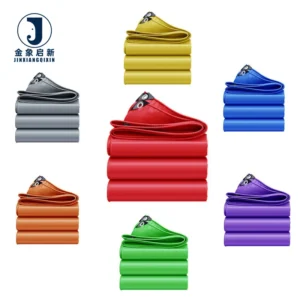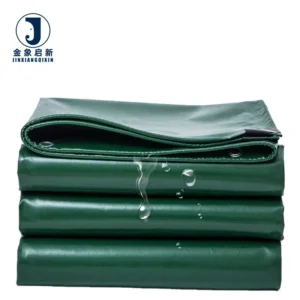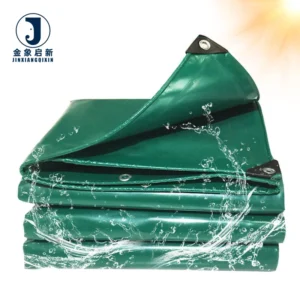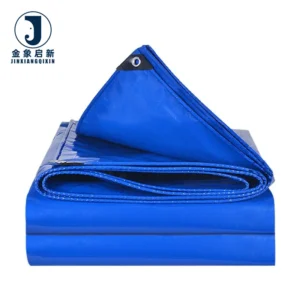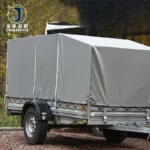
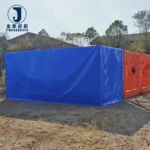
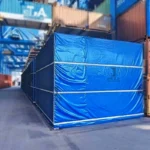
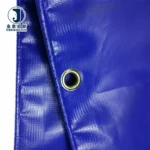
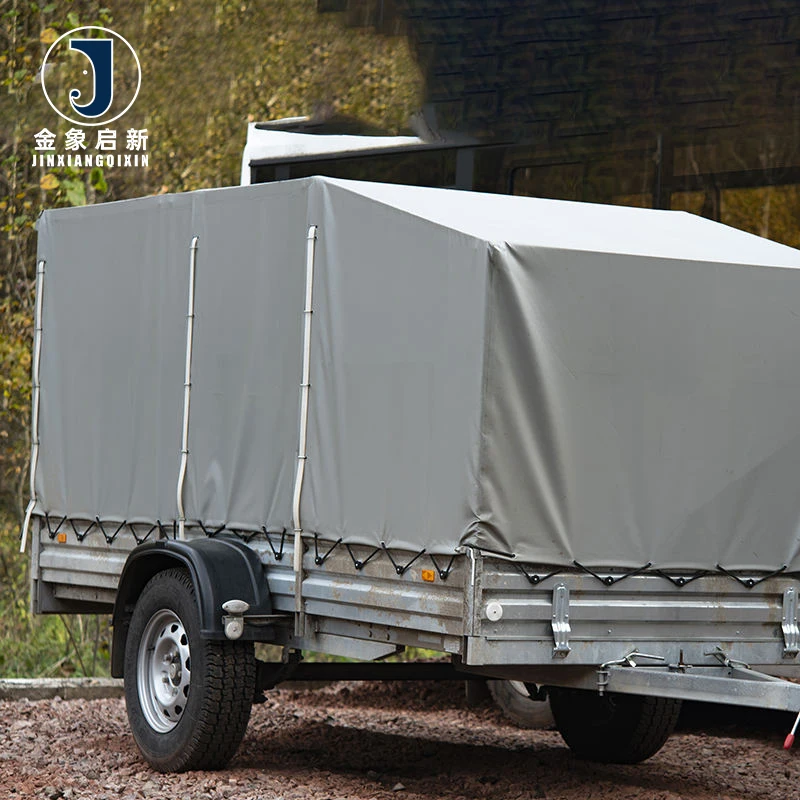
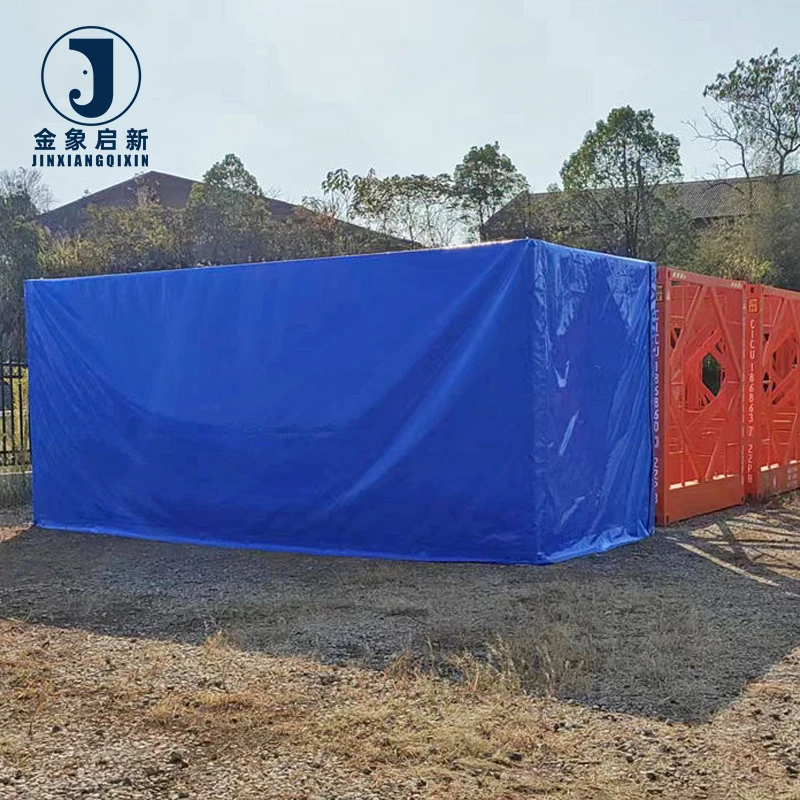
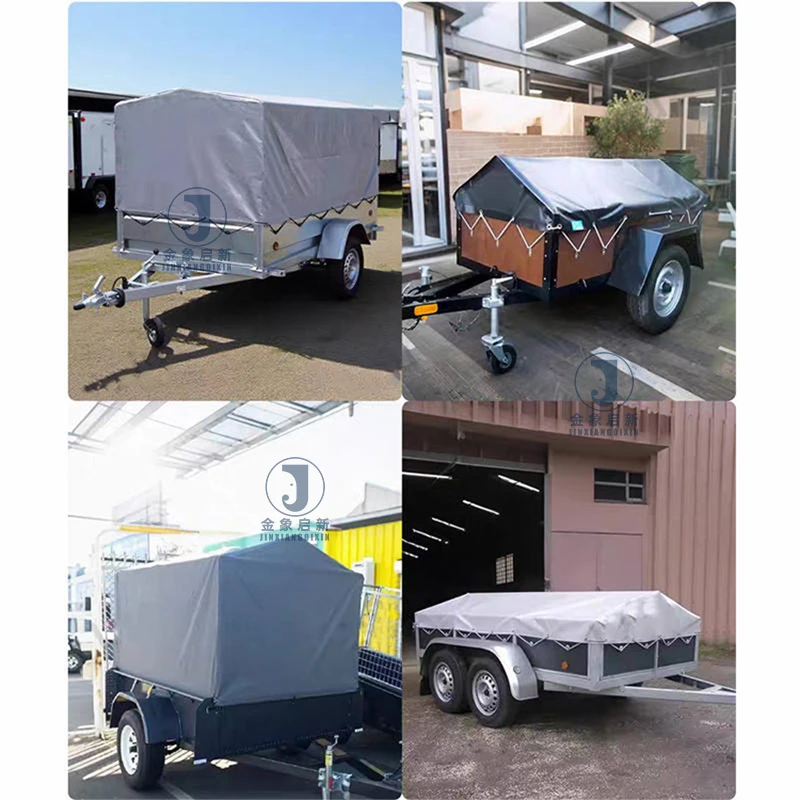
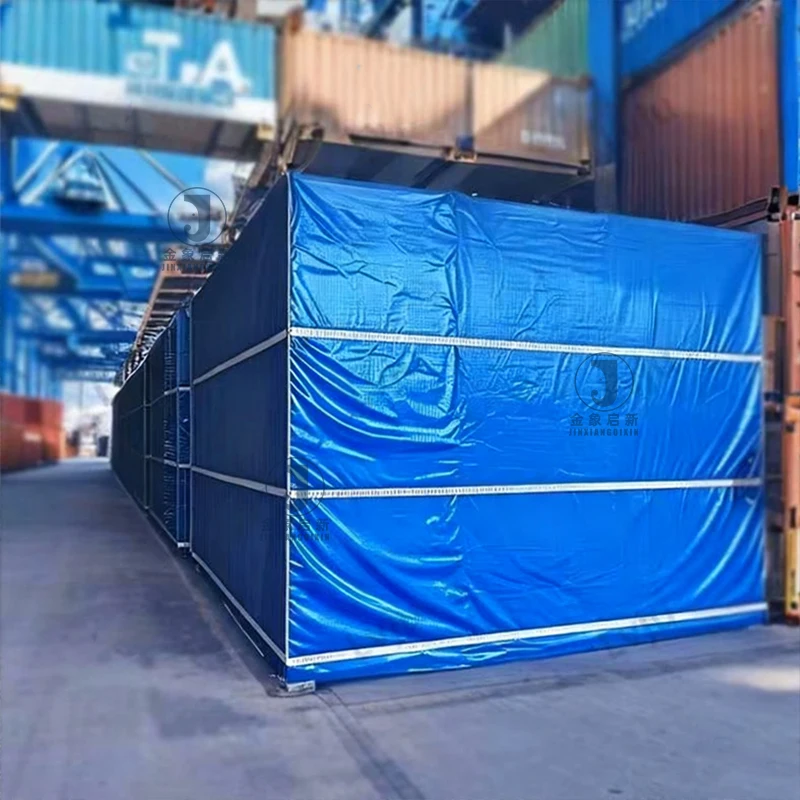
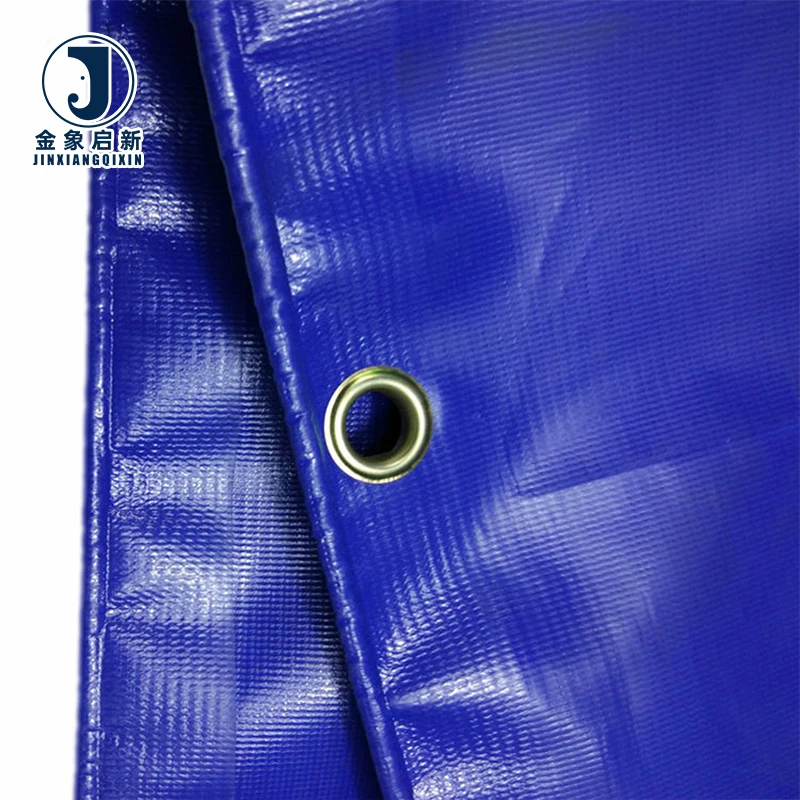
Coating adhesion control — hot melt and lamination processes maintained at every stage to keep coating bonded to the base fabric through flex and load stress.
Technical Specifications
| Parameter | Value |
|---|---|
| Product Type | PVC Coated Tarpaulin |
| Material | 100% high toughness polyester yarn with PVC coating |
| Coating Technology | Lamination technology and hot melt coating technology |
| Weight (Medium-duty) | 400–500 g/m² |
| Thickness (Medium-duty) | 0.35–0.45 mm |
| Knitting Density (Medium-duty) | 500D |
| Tensile Strength (Medium-duty) | Warp 1500–2000 / Weft 1200–1800 N/5cm |
| Weight (Heavy-duty) | 700–1000 g/m² |
| Thickness (Heavy-duty) | 0.70–1.0 mm |
| Knitting Density (Heavy-duty) | 1000D |
| Tensile Strength (Heavy-duty) | Warp 2000–2500 / Weft 1800–2200 N/5cm |
| Weight (Super Heavy) | 1100–1500 g/m² |
| Thickness (Super Heavy) | 1.2–1.5 mm |
| Knitting Density (Super Heavy) | 500D–2000D |
| Tensile Strength (Super Heavy) | Warp 2500–3000 / Weft 2200–2800 N/5cm |
| Fire Retardant Standard | B1 per DIN 4102 |
| Waterproof | Yes |
| Cold Resistant | Yes (grade available on request) |
| Mold Proof | Yes |
| Anti-Static | Treatment available (test basis on request) |
| UV Treatment | Weather resistance 3–5 years (test basis on request) |
| Welding Tear Strength | Excellent |
| Color Fastness | Best color fastness (test method on request) |
| Certification | ISO, CE |
Application Suitability
| Application | Exposure & Requirement |
|---|---|
| Mining ventilation duct | Underground fire risk, static discharge potential, continuous airflow friction, B1 fire compliance required |
| Tunnelling duct fabric | Confined space flame safety, longitudinal tension from air pressure, abrasion from particulate-laden air |
| Membrane and inflatable structures | Biaxial tension loads, long-term UV exposure, weld integrity at curved seams, fire code compliance |
| Aviation hangar ducting | Fuel vapour environment requiring anti-static treatment, fire retardant certification for enclosed airspace |
| Warehouse temporary enclosure | Wind-driven rain, solar exposure, fire safety regulation on temporary structures, colour consistency across panels |
| Industrial pipe canopy | Chemical splash, thermal cycling, structural flex under snow or wind load |
Why "Flame Retardant" Without a Test Report Fails the Site Inspector
A B1 test report per DIN 4102 is what the inspector will ask for — not a claim on the quotation.
Ventilation and temporary structure contractors routinely receive fabric labelled "flame retardant" that arrives with no supporting documentation. The site safety officer then rejects the material, the installation is halted, and replacement lead times push the project schedule. This Fire Retardant PVC Tarpaulin aftermarket supplier ships the material with a B1 test report that references the specific production batch. The gap between what the quotation says and what the inspector accepts closes before the rolls leave the factory.
Fabricators working on regulated construction sites or underground mining projects have seen deliveries rejected because the fire retardant grade did not match the local building code or mining regulation cited in the contract specification. Confirming the applicable standard at inquiry stage prevents that outcome. [NEED_CITE: DIN 4102 fire classification for building materials]
Coating Method and Its Effect on Ventilation Duct Weld Integrity
Hot melt coating technology fuses the PVC layer directly into the polyester yarn structure, producing a coating-to-yarn bond that resists delamination when the fabric flexes under duct air pressure. This matters for ventilation contractors because longitudinal seams on duct runs carry constant stress from internal pressure and external handling during installation. A Fire Retardant PVC Tarpaulin aftermarket supplier using hot melt processes delivers fabric where the weld line holds at or near the base fabric tensile strength rather than failing at the coating interface.
Lamination technology, by contrast, bonds pre-formed PVC films to the base fabric through heat and pressure. This method suits applications where a smoother surface finish is needed for cleaning or where cost control on lighter weight grades is a priority. Both methods are available across the weight range, and the choice between them should align with the weld method your fabrication shop uses — high-frequency welding behaves differently on hot melt versus laminated surfaces.
Fire Retardant Certification and the Compliance Paperwork Chain
Specifying B1 grade per DIN 4102 is the starting point, not the finish line. Mining and tunnelling contractors typically need the fire test report cross-referenced to their site safety plan, and aviation hangar duct installations may require additional anti-static documentation alongside the flame retardant certificate. The Fire Retardant PVC Tarpaulin aftermarket supplier must provide documentation that the site safety officer can file directly without requesting further verification. [NEED_CITE: mining ventilation fire safety requirements for coated fabric ducts]
When multiple rolls go into a single duct run or membrane structure, colour consistency across the batch also becomes a compliance concern — visible colour variation between adjacent panels can signal inconsistent coating chemistry, which triggers further inspector scrutiny on fire performance uniformity. Roll-to-roll colour and weight verification at pre-shipment inspection addresses this before the material reaches site.
Reading the Specification Sheet: What Weight, Denier and Tensile Strength Actually Tell You
GSM alone does not determine how the fabric performs under load. A 1000 g/m² fabric with low denier base yarn may have high coating weight but lower tear resistance than a lighter fabric woven from 2000D yarn. The knitting density — whether 500D for medium-duty or up to 2000D for super heavy — defines how many yarns carry the load in each direction, and the tensile strength figures reflect that combined contribution of yarn and coating together. [NEED_CITE: tensile and tear test methods for coated fabrics per ISO 1421]
Coating method affects how well the fabric welds and how the seams age. Hot melt coating produces deeper penetration into the base weave, which typically yields stronger high-frequency welds — critical for duct seams carrying internal air pressure. Lamination gives a more uniform surface thickness, aiding consistent weld parameters across the roll width. Understanding which method your fabrication process is set up for will determine whether the finished seam or the base fabric becomes the weak point in the installed product.
The Cost of Specifying Blind: What Goes Wrong When Grade and Application Do Not Match
Fabricators who order fire retardant duct material without confirming the exact grade required by the project specification face rejection at site inspection. The cost is not only the replacement material — it includes the labour to remove and reinstall, the delayed project milestone, and the strained relationship with the principal contractor. Underground mining projects in particular enforce strict documentation chains where a missing test report halts work immediately.
Colour variation between rolls installed side by side on a warehouse or membrane structure signals to the client that quality control may be inconsistent — raising questions about whether fire performance is uniform across the batch. Weight discrepancy between the quoted GSM and what arrives on site reduces tensile and tear margins, leading to premature seam failure at flex points where the duct or structure moves under load. [NEED_CITE: coated fabric seam failure modes under cyclic flex loading]
Why Ventilation and Structure Contractors Source Here
Three full production lines and dedicated coating equipment maintain batch-to-batch consistency across roll weight, colour and coating thickness — verified at every production stage rather than only at final inspection.
A dedicated research and development team handles material selection for specific ventilation and structural requirements, including anti-static treatment formulation and fire retardant grade confirmation against your project specification.
Pre-shipment inspection covers weight verification, coating adhesion check and colour comparison across all rolls in the order, with the inspection record included in the shipping documentation package.
Samples for custom width, colour or treatment combinations are developed rapidly, allowing fabrication trials and weld parameter testing before the full production run commits.
ISO and CE certified production processes ensure that the documentation accompanying each shipment meets the compliance requirements of regulated mining, tunnelling and construction projects.
Documentation & Verification
- B1 fire retardant test report per DIN 4102 issued for the specific production batch
- Material specification sheet stating GSM, base fabric denier and coating method for each roll
- Pre-shipment inspection record confirming weight and thickness against the original quotation
- ISO and CE certificates included in the documentation package for site compliance filing
- Anti-static test report provided where treatment is specified for ventilation duct applications
Fabrication, Handling & Storage
- Hot melt coated rolls require adjusted high-frequency weld dwell times compared to laminated grades
- Store PVC coated rolls upright on pallets to prevent flat-spot creases across the roll width
- Allow cold-stored rolls to reach ambient temperature before unrolling to prevent coating crack
- Use compatible PVC welding tape on seams matching the coating method — hot melt or lamination
- Clean surfaces with neutral pH detergent only to preserve fire retardant and anti-static treatment integrity
What to Include With Your Inquiry
Provide the specific fire safety standard your project specification references — whether DIN 4102 B1 or a regional equivalent — so the test report aligns with what your site inspector will review. Confirm whether anti-static treatment is required for your ventilation environment and which test basis your safety plan cites.
State the roll width and quantity needed per shipment, along with whether you require finished cut panels or full rolls for your own fabrication line. Colour references or RAL codes help confirm batch consistency across your full order volume before production begins.
Frequently Asked Questions
Q: Can you provide a B1 fire retardant test report that satisfies mining or construction site compliance?
A: Yes. Each shipment of fire retardant fabric includes a B1 test report per DIN 4102 referenced to the production batch. Confirm the specific standard your site safety plan requires at inquiry stage so the documentation matches the inspector’s checklist. Additional anti-static test reports are supplied where treatment is specified for underground or aviation environments.
Q: How do you confirm GSM on arrival matches the GSM on the quotation?
A: Weight verification is conducted at each production stage and again during pre-shipment inspection. The inspection record included with your shipping documentation states the measured GSM per roll. Any deviation outside tolerance triggers corrective action before dispatch, so the material arriving at your fabrication facility matches the specification you approved.
Q: What is the difference between hot melt coating and lamination for weld strength?
A: Hot melt coating penetrates the base yarn structure, producing stronger high-frequency welds suited to pressurised duct seams. Lamination bonds pre-formed PVC films to the fabric surface, offering uniform thickness for consistent weld parameters on lighter weight grades. Your fabrication process and the installed stress conditions determine which method is appropriate.
Q: Can you supply custom width rolls with anti-static treatment for duct fabrication?
A: Custom widths are available across the weight range with anti-static treatment applied during coating. Provide the required width, the fire retardant grade and the anti-static test basis your project specifies. Samples are produced for weld parameter testing before full roll production to confirm fabrication compatibility.
Q: What documentation ships with the rolls for regulated project compliance?
A: Each shipment includes the material specification sheet, B1 fire retardant test report, pre-shipment inspection record, ISO and CE certificates, roll packing list and certificate of origin. Additional documentation for customs or project-specific compliance requirements is arranged during the order confirmation stage.