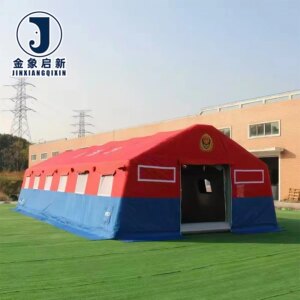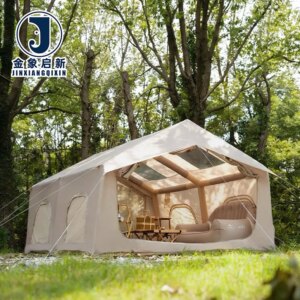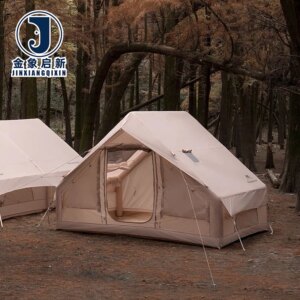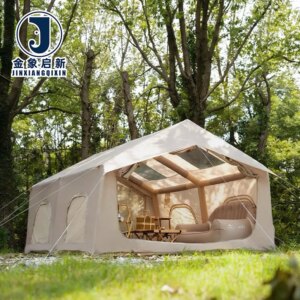

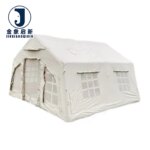
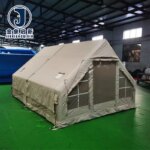
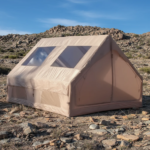

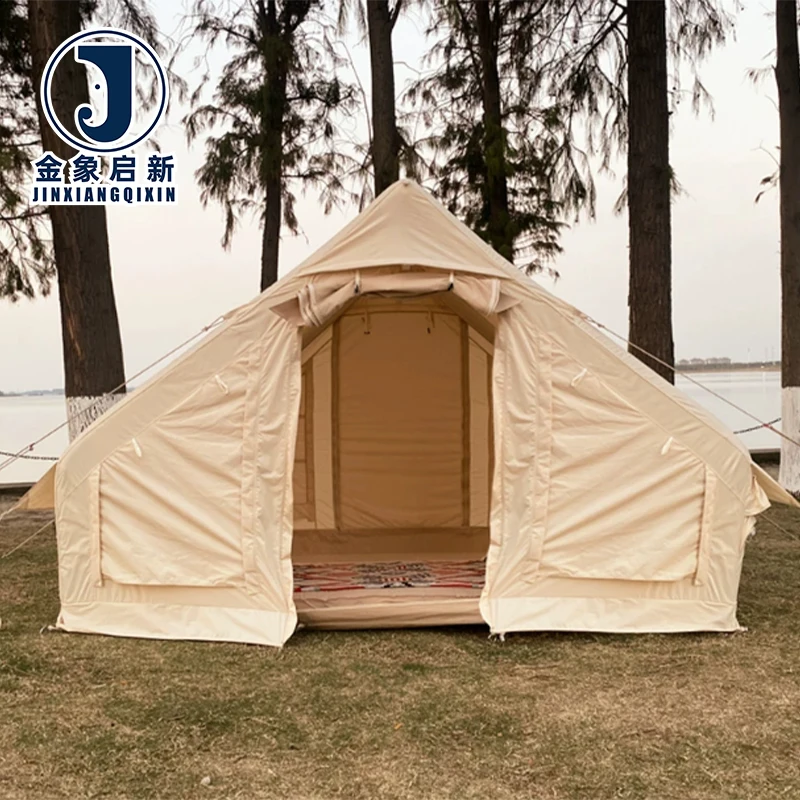
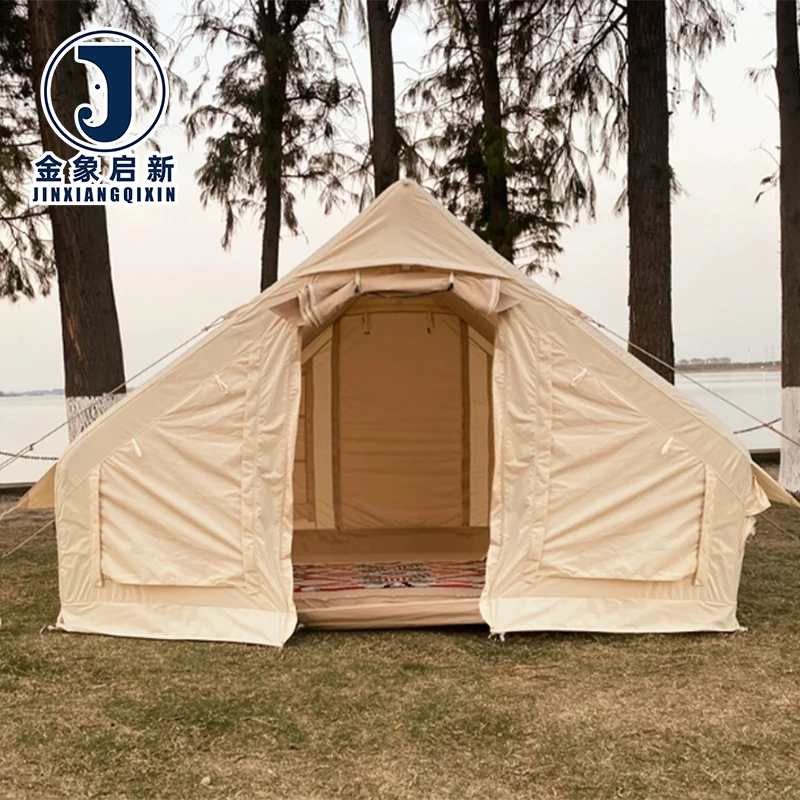
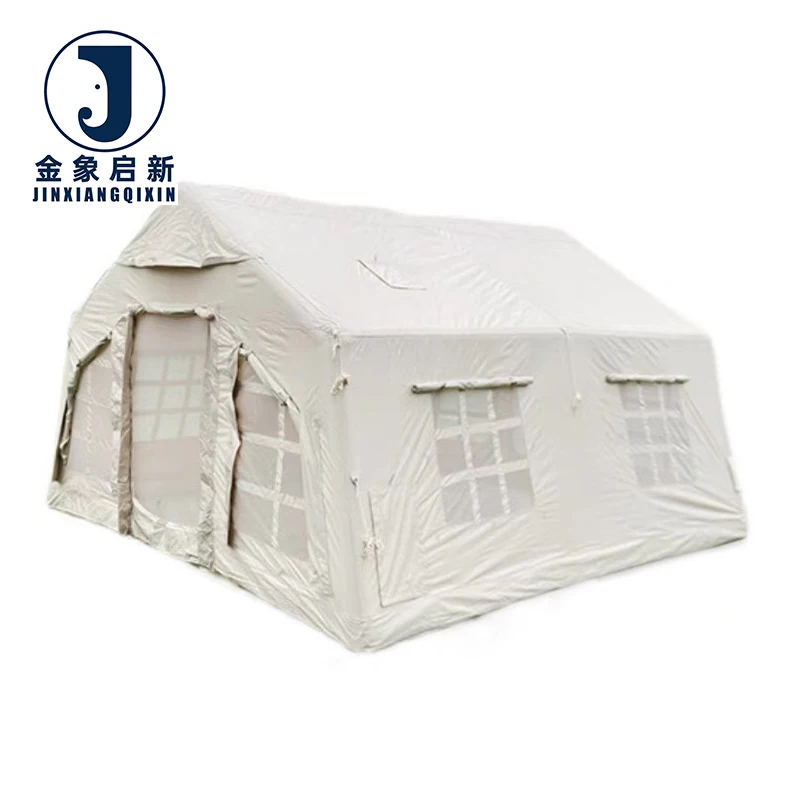
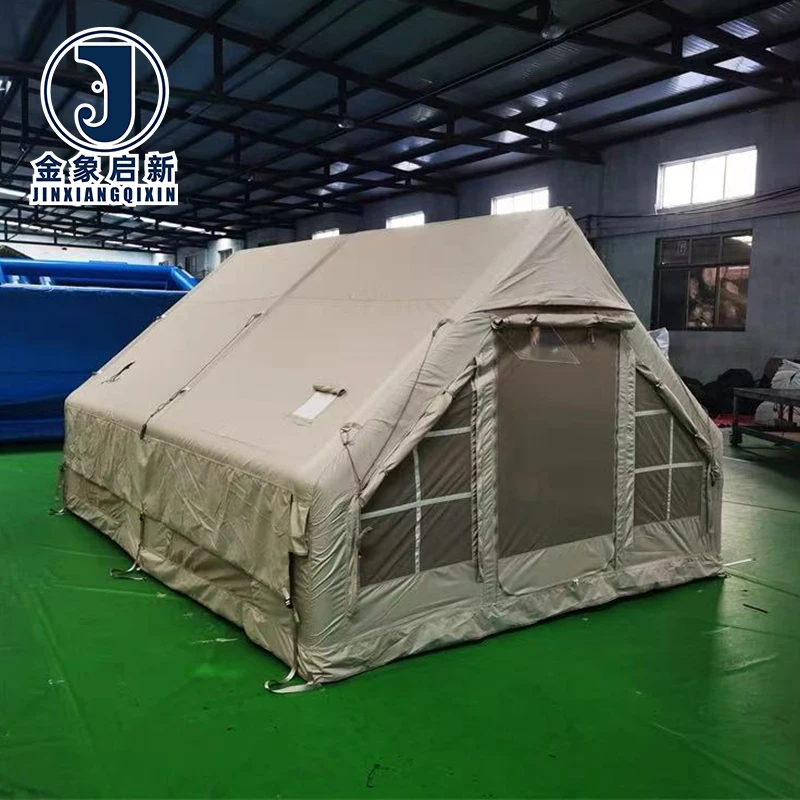
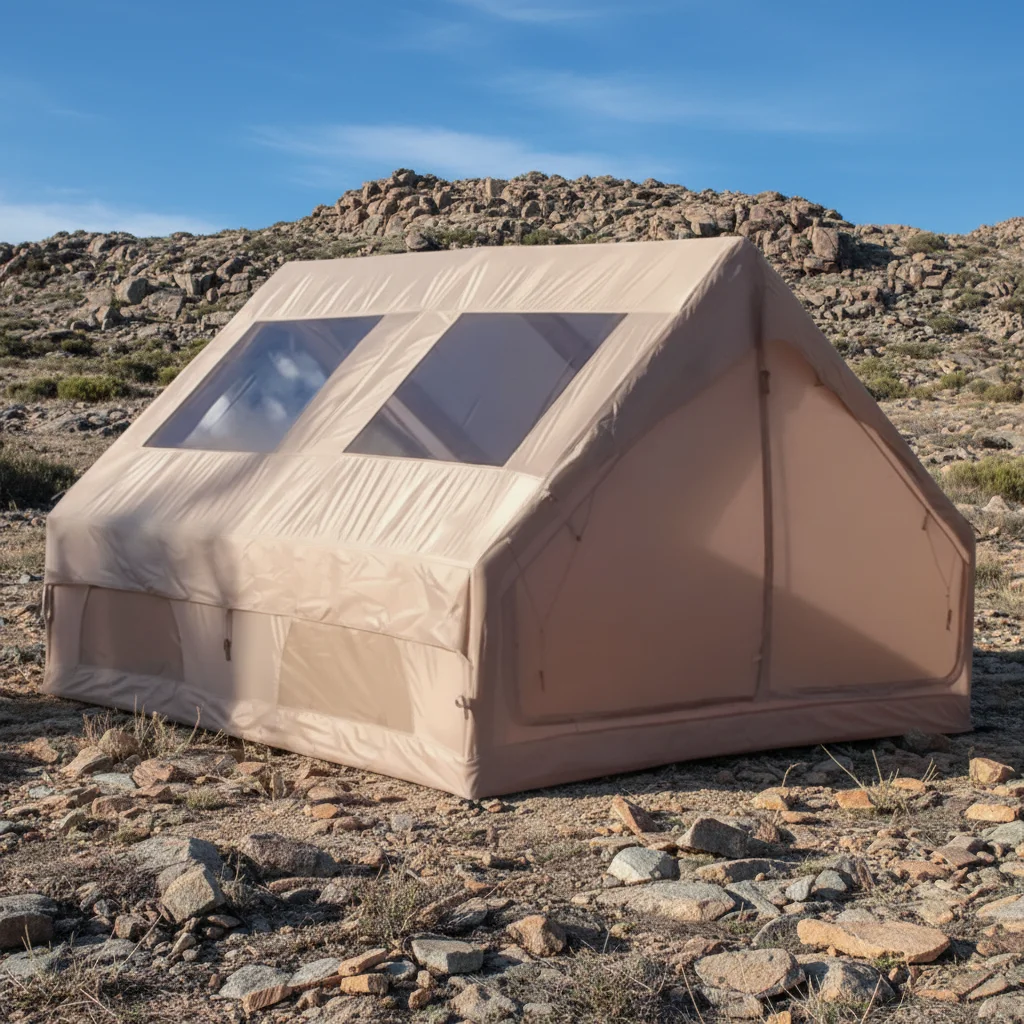

Deep Process Control Over Coating Weight — PVC tarpaulin for inflatable structures produced with in-process QA at every coating stage, ensuring consistent adhesion and fire-retardant treatment uniformity across production batches.
Technical Specifications
| Parameter | Value |
|---|---|
| Product Type | Inflatable Tent |
| Core Material | PVC Tarpaulin |
| Key Performance | Waterproof, UV-resistant, Tear-resistant, Fire-retardant, Anti-static |
| Season Rating | 4-Season |
| Product Form | Inflatable structure with automatic opening mechanism |
| Standards | ISO9001, ISO14001, ISO45001, CE |
| Customization | OEM & ODM (sample customization, pattern printing, material selection, product design) |
Application Suitability
| Application | Exposure & Requirement |
|---|---|
| Commercial camping operations | Frequent inflation/deflation cycles, prolonged sun and rain exposure, guest safety compliance |
| Industrial field accommodations | Remote site deployment, harsh weather, structural integrity under continuous inflation pressure |
| Specialized outdoor work shelters | Rapid setup requirements, wind load resistance, temperature fluctuations across seasons |
| Aviation ground support structures | Anti-static surface requirements, fire safety regulations, frequent relocation |
| Mining and tunnelling camps | Dust and particulate exposure, strict fire codes, heavy-duty abrasion from site conditions |
What Fire-Retardant Certification Actually Means for Inflatable Shelters
An inflatable tent without a verified fire-retardant grade is a liability, not a shelter.
Mining sites, aviation facilities, and commercial glamping operations each enforce different fire safety codes. A PVC inflatable tent fabric fire retardant anti-static certified claim means nothing unless the specific grade matches your jurisdiction — M2 for France, B1 for Germany, NFPA 701 for the United States. We see contractors order inflatable fabric assuming one fire rating covers all markets, only to fail site inspection because the documentation does not match the local authority’s standard. [NEED_CITE: fire classification standards for temporary structures in mining and aviation]
The automatic opening mechanism on this inflatable camping tent depends on airtight seams and uniform fabric tension. When fire-retardant additives are applied inconsistently during coating, the thermal behaviour varies across the structure, creating unpredictable performance under heat exposure. Verifying the exact grade before production begins avoids costly replacement after failed compliance checks.
Structural Behaviour Under Continuous Inflation Pressure
The PVC tarpaulin used in this inflatable structure must maintain dimensional stability while holding internal air pressure across varying outdoor temperatures. In cold conditions, PVC stiffens and becomes more prone to cracking at fold points if the plasticiser formulation is inadequate. During summer heat, the material softens and the inflatable columns can deform under wind load if the base fabric denier and coating weight are not balanced for the structure’s size. This 4-season inflatable tent design accounts for these thermal shifts through material selection during the OEM/ODM customisation process.
Each inflation cycle stresses the welded seams at the column junctions. The PVC inflatable tent aftermarket supplier must ensure that heat-welded joints achieve peel strength equal to or exceeding the base fabric tensile capacity, because the columns bear the entire structural load without a metal frame.
Anti-Static Treatment Verification for Hazardous Environments
Aviation ground support and mining operations require inflatable shelters that do not accumulate static charge, which can ignite fuel vapours or coal dust. Anti-static treatment involves incorporating conductive additives into the PVC coating or applying a topical finish that dissipates charge across the surface. The required surface resistivity threshold depends on the specific hazardous zone classification at the deployment site. [NEED_CITE: surface resistance standards for anti-static materials in explosive atmospheres]
We supply inflatable tent fabric with anti-static treatment available in grades aligned to common industrial requirements — confirm the surface resistance value required for your operational zone before placing an order. Test documentation accompanies each batch so site safety officers can verify compliance without sending samples to an independent lab.
Material Properties That Define Inflatable Structure Performance
The base fabric denier and weave density determine how the PVC tarpaulin resists tearing when punctured by sharp objects on site or stressed by uneven inflation. A higher denier yarn in the warp direction provides greater tensile strength along the length of the roll, which matters when columns are oriented vertically. The coating weight applied to each side affects the overall GSM and directly influences heat-weld parameters — heavier coatings require adjusted temperature and dwell time to achieve full fusion without burning through the PVC layer.
Surface finish selection influences both practical maintenance and visual presentation. Glossy finishes shed dirt more readily and are easier to wipe clean in dusty mining environments, while matte finishes reduce glare for aviation applications where reflective surfaces create visibility hazards. Pattern printing and branding can be applied during the customisation process, but the ink adhesion must be tested against the specific surface treatment to prevent flaking after repeated inflation cycles.
Specification Mismatches That Cause Field Failures
Ordering inflatable tent fabric without matching the material specification to the deployment environment leads to failures that are expensive to remedy mid-project. Anti-static treatment applied at an insufficient concentration passes visual inspection but fails surface resistance testing when the safety officer measures it on site. Fire-retardant grades that meet one country’s standard do not automatically satisfy another, and re-certification is rarely feasible once the structure is fabricated. [NEED_CITE: consequences of unverified fire-retardant claims on temporary industrial structures]
Colour inconsistency across rolls becomes visible when multiple inflatable units are deployed side by side at a commercial camping site, damaging the operator’s brand presentation. Seam delamination at column junctions occurs when the heat-weld temperature was set for a different coating formulation than the one actually supplied.
Why Source Inflatable Fabric From This Production Line
Three full production lines equipped with 36 sets of professional processing equipment handle bulk inflatable fabric orders with consistent output scheduling and on-time delivery across production runs.
A 10-technician R&D team manages material selection, structural pattern development, and sample fabrication for custom inflatable tent projects, delivering prototypes within days for buyer evaluation before committing to full production.
Dedicated QA and QC staff inspect every production stage — coating weight verification, adhesion testing, fire-retardant additive concentration checks, and anti-static surface measurement — rather than relying on end-of-line sampling alone.
ISO9001, ISO14001, ISO45001, and CE certifications are maintained across the production system, with documentation provided as part of each shipment rather than displayed on a website without traceability.
Sample development capability allows buyers to test inflatable column weld strength, inflation behaviour, and treatment verification on a small batch before authorising the full order quantity.
Documentation & Verification
- Material specification sheet stating base fabric denier, coating type, and fire-retardant or anti-static treatment details for this inflatable tent order
- Fire-retardant test report issued per the specific grade standard applicable to the buyer’s target market
- Anti-static surface resistance measurement data included in pre-shipment inspection records
- ISO9001, ISO14001, ISO45001, and CE certificates provided with dispatch documentation
- Pre-shipment batch inspection report covering coating weight consistency and weld integrity
- Certificate of origin and customs documentation for international inflatable fabric shipments
Fabrication, Handling & Storage
- Heat-weld temperature and dwell time must be calibrated to the specific PVC coating weight to prevent seam delamination at inflatable column junctions
- Store rolls upright on pallets in dry conditions to prevent permanent creasing that compromises inflation uniformity
- Allow cold-stored PVC tarpaulin rolls to acclimatise before unrolling to avoid cracking the coating at low temperatures
- Use compatible PVC adhesive and patch material from the same coating formulation for field repairs on inflatable structures
- Verify surface finish type before selecting printing ink to ensure adhesion survives repeated inflation and deflation cycles
- Plan cutting layouts to minimise transverse welds across inflatable columns where internal pressure concentrates stress
Requesting a Material Quote for Your Inflatable Project
Specify the deployment environment — temperature range, wind exposure, and site hazards such as fuel vapours or combustible dust — so the correct fire-retardant grade and anti-static treatment level can be confirmed before sampling.
Provide the target market or site authority having jurisdiction so that compliance documentation matches the applicable standard rather than a generic test report.
Indicate required roll width, annual volume, and whether you need raw inflatable tent fabric or finished fabricated components with welded column assemblies and valve fittings.
Frequently Asked Questions
Q: Which fire-retardant grades are available for inflatable tent fabric?
A: Fire-retardant treatment is applied to meet specific market standards including M2, B1, and NFPA 701. The applicable grade depends on your deployment jurisdiction and site authority requirements. Confirm the exact standard before sample production so that test documentation aligns with your compliance obligations and avoids rejection at site inspection.
Q: How is anti-static performance verified before shipment?
A: Anti-static surface resistance is measured during pre-shipment quality inspection using calibrated testing equipment. The measurement data is recorded in the batch inspection report that accompanies your shipment. Confirm the specific surface resistivity threshold required by your site safety classification so we can verify the treatment meets your operational requirements before dispatch.
Q: Can custom inflatable structures be sampled before bulk production?
A: Sample development is available through the OEM and ODM customisation service, covering material selection, structural design, and pattern printing. A 10-technician R&D team produces prototypes for buyer evaluation within days. Once the sample is approved for inflation performance, weld integrity, and treatment verification, full production proceeds against the confirmed specification.
Q: What documentation ships with each inflatable fabric batch?
A: Each order ships with a material specification sheet, fire-retardant and anti-static test reports where applicable, pre-shipment inspection records, ISO and CE certificates, packing list, and certificate of origin. The documentation package is compiled per order so that compliance records are traceable to your specific production batch and can be presented to site inspectors without delay.
Q: What is the minimum order for custom inflatable tent specifications?
A: Minimum quantities vary depending on the customisation scope — custom widths, specific fire-retardant grades, and anti-static treatments each have different production thresholds. Provide your required specification, annual volume, and roll dimensions so that an accurate minimum and lead time can be quoted. Typical custom orders involve multi-week lead times for material preparation and treatment application.