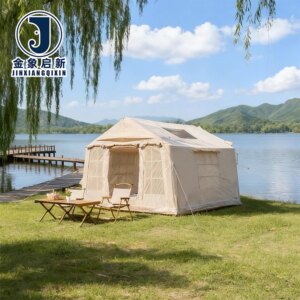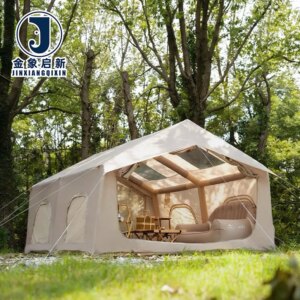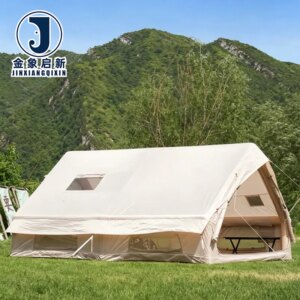
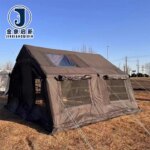
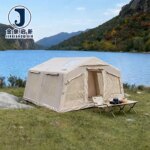
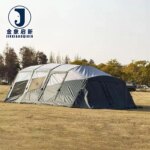
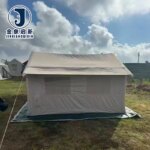
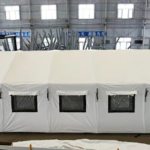
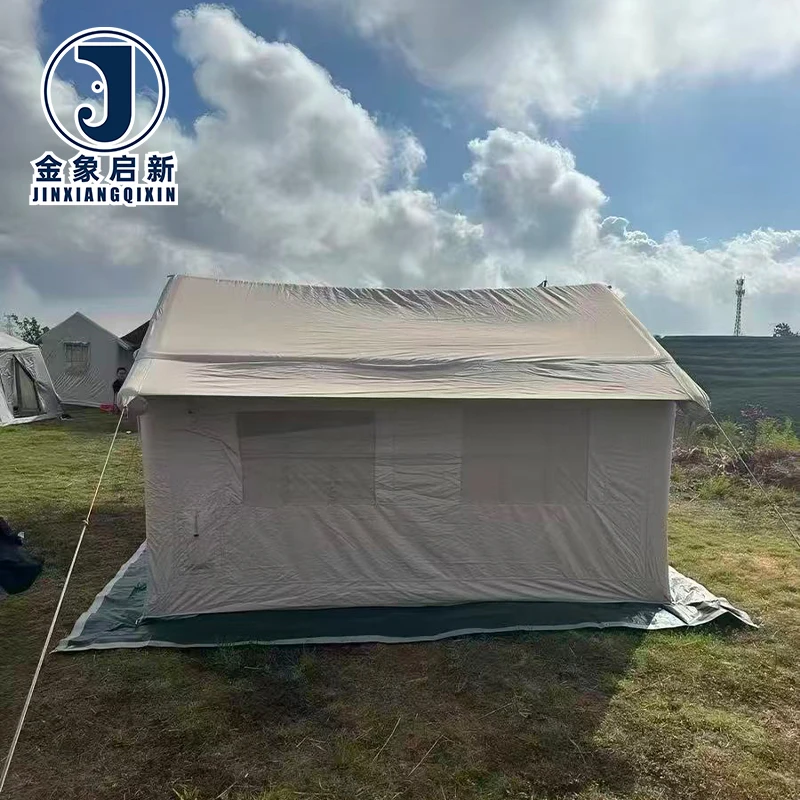
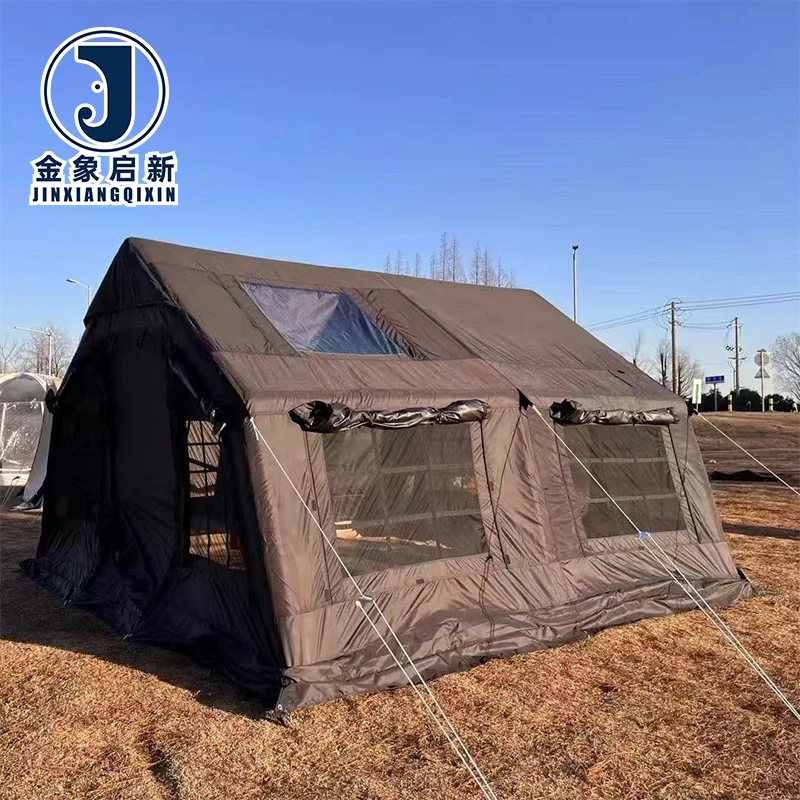
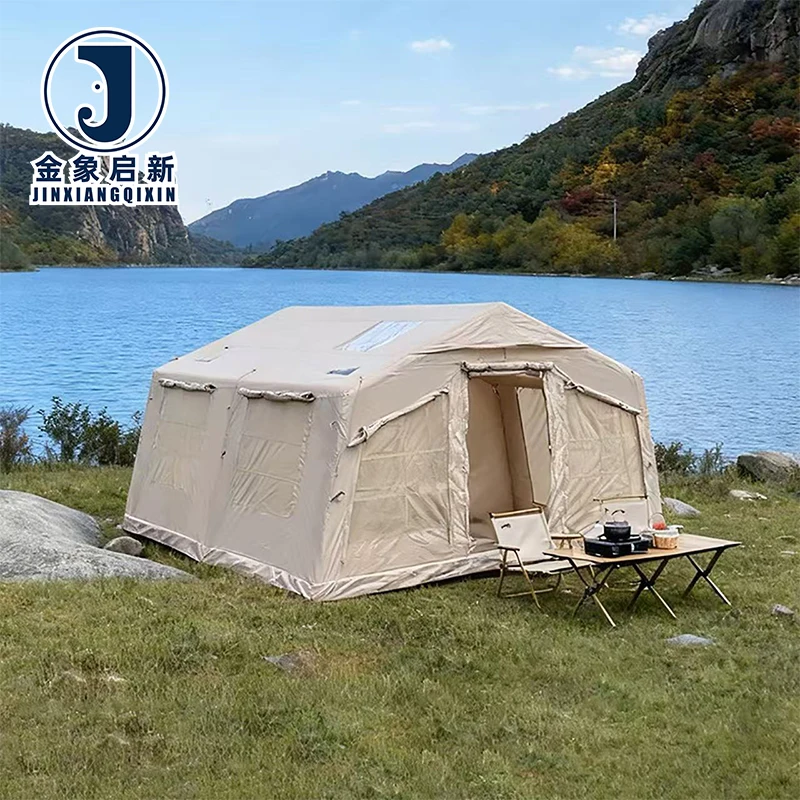
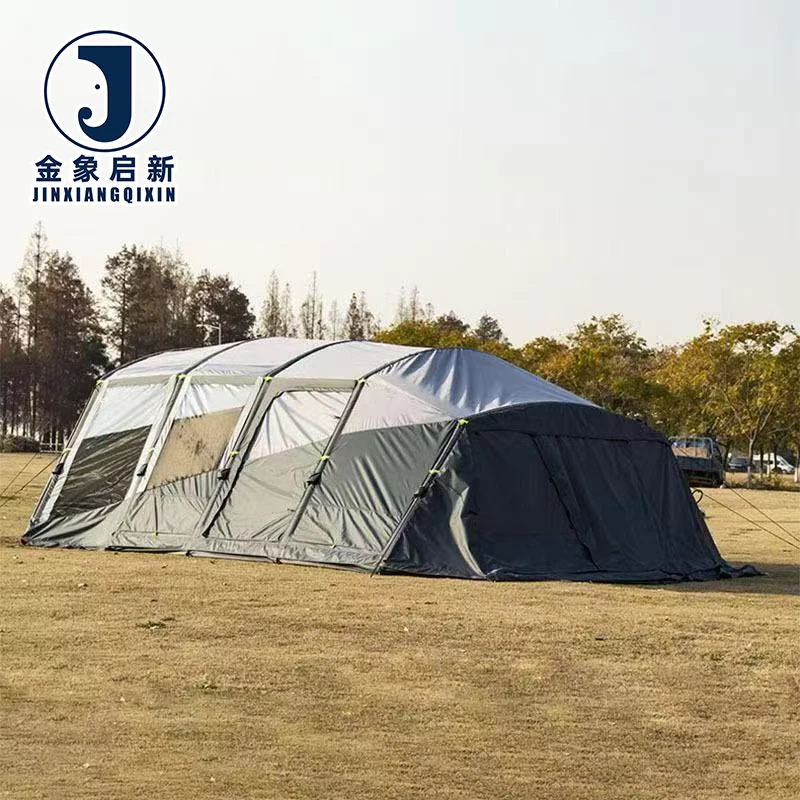
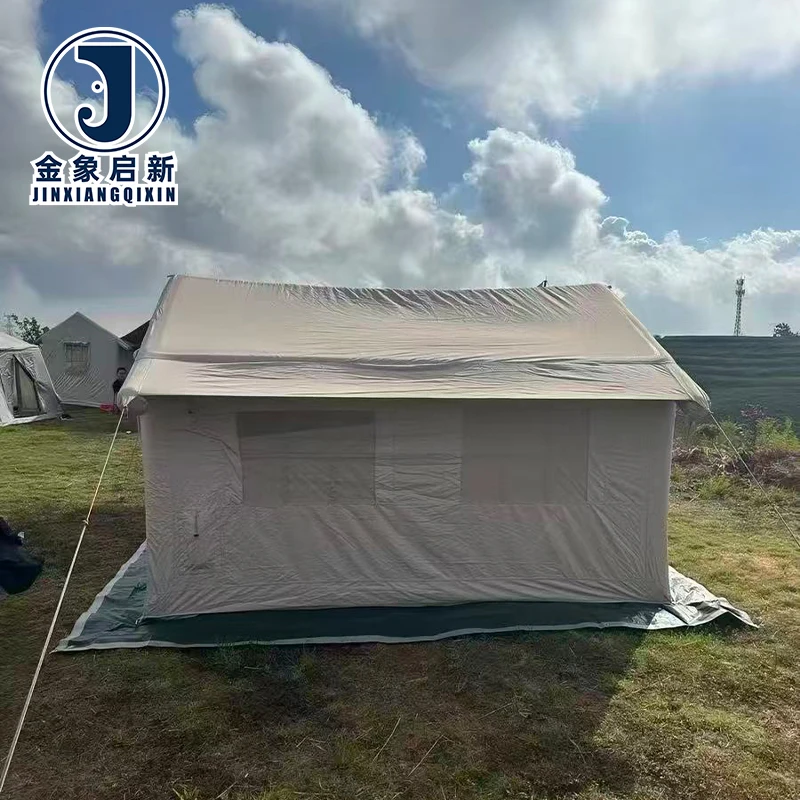
Automated Production Control — Every inflatable tent roll undergoes in-process QA across coating weight, fabric tension, and seam integrity before leaving the facility.
Technical Specifications
| Parameter | Value |
|---|---|
| Product Type | Inflatable Tent |
| Core Material | Oxford Waterproof Fabric |
| Water Resistance | ≥10,000mm H₂O (source value — verify against manufacturer catalog) |
| UV Protection | UPF 50+ (source value — verify against manufacturer catalog) |
| Temperature Tolerance | -30°C to 70°C (source value — verify against manufacturer catalog) |
| Tensile Strength | ≥300N/5cm (test basis not stated in source) |
| Tear Resistance | ≥150N (test basis not stated in source) |
| Manufacturing Tolerance | ±2cm for tent dimensions |
| Key Features | Automatic Opening, Four-Season Design, Single Layer Construction, Extended Type |
| Capacity | 4-6 Person |
| Customization | OEM & ODM, sample customization, pattern printing |
| Standards | ISO9001, ISO14001, ISO45001, CE |
Application Suitability
| Application | Exposure & Requirement |
|---|---|
| Mining and tunnelling site temporary command or rest shelters | Rapid deployment, temperature extremes, compliance with site safety documentation |
| Aviation ground support inflatable enclosures | Wind load, fuel proximity, documented fire performance certification |
| Emergency response staging structures | Immediate inflation, four-season weather exposure, repeated pack-and-redeploy cycles |
| Construction site temporary workspace | UV exposure, abrasion from equipment movement, dust and moisture ingress |
| Outdoor industrial event structures | Public-facing appearance, branding surface, UV and rainfall resistance |
Why Compliance Documentation Separates Industrial Inflatable Tents from Consumer Camping Gear
An inflatable tent without verifiable certification paperwork is a liability on any regulated job site.
Most inflatable shelters sold online are designed for weekend camping and carry no industrial compliance trail. When a mining contractor or aviation ground crew deploys a structure on site, safety auditors ask for material test reports, fire classification certificates, and batch traceability — not a product listing screenshot. Sourcing an Inflatable Tent certified for industrial environments means the manufacturer must produce documentation that aligns with the regulatory framework of your market, and that capability is far less common than the product itself [NEED_CITE: site safety compliance requirements for temporary structures in mining and aviation].
Fire Performance Expectations for Temporary Inflatable Structures
Temporary shelters on industrial sites frequently sit within regulated zones where fire classification is non-negotiable. For mining, tunnelling, and aviation applications, the inflatable tent must meet site-specific fire-retardant standards before deployment is approved. The Oxford waterproof fabric used here is available in flame retardant grades — confirm the grade required for your market and request the corresponding test report before placing a production order. Without a documented classification, the structure may fail the site safety audit regardless of its actual material performance.
Automatic Opening Mechanism and Rapid Deployment Logic
The automatic opening system is engineered for scenarios where minutes matter: emergency response staging, sudden weather events on construction sites, or shift-change shelters in remote mining operations. Unlike manual pole-and-sleeve assembly, the inflatable frame deploys from a single inflation point, reducing setup to a matter of minutes with minimal crew. This matters most when the Inflatable Tent certified for your project must be operational before the next shift arrives or before incoming weather compromises the work area [NEED_CITE: rapid deployment shelter performance standards for emergency response operations].
Temperature Tolerance and Material Behaviour Across Seasons
The stated -30°C to 70°C operating range addresses two distinct failure modes. At the cold end, PVC and coated Oxford fabrics can stiffen and become brittle, leading to cracking at fold lines during packing or inflation stress at the seam. At the hot end, coating adhesion weakens and the airframe tubes soften under internal pressure, causing structural sag. A four-season formulation aims to keep the fabric pliable in sub-zero deployment while maintaining dimensional stability under high ambient heat and direct UV load. The UPF 50+ treatment further limits UV-driven coating degradation over extended outdoor exposure, though buyers should verify the test basis before specifying for high-UV regions.
Waterproof Rating and What It Means for Continuous Exposure
A hydrostatic head rating of ≥10,000mm H₂O indicates the fabric can withstand substantial water pressure before moisture penetrates the coating layer. For inflatable shelters used in monsoon-prone mining regions or as emergency medical staging areas, this rating provides a margin well beyond typical rainfall loads. However, the waterproof performance of the finished tent also depends on seam sealing, zipper flap design, and inflation tube gasket integrity. Always request the batch-specific test record alongside the material specification sheet [NEED_CITE: hydrostatic head test methods for coated fabrics per ISO 1421].
What Happens When Specification Gaps Surface After Delivery
A tent that performs well in the sample can still fail in production if batch-level quality controls are absent. Coating weight that drifts below specification reduces waterproof performance and shortens service life under UV exposure. Dimensional tolerance beyond ±2cm means the inflatable frame may not align properly with the intended ground footprint, causing stress concentrations at anchor points. Fire-retardant treatment applied inconsistently across a batch creates zones that pass testing and zones that do not — a problem discovered only during the site safety inspection, when rejection costs far more than the material itself [NEED_CITE: batch consistency requirements for fire-retardant coated fabrics].
Why Industrial Buyers Source This Inflatable Tent Here
The 10-person R&D team handles custom sizing, pattern printing, and performance modifications specific to your deployment scenario, with samples developed within days rather than weeks.
Three full production lines and 36 sets of professional equipment support bulk orders while maintaining batch-to-batch consistency across the Oxford waterproof fabric range.
Dedicated QA/QC operates at every production stage, with 100% pre-shipment inspection ensuring each Inflatable Tent certified for your project meets the documented specification before dispatch.
Nearly 30 years of focused coated fabric production experience underpins process control over coating weight, adhesion, and seam behaviour — factors that directly determine field performance.
Full certification packages including ISO9001, ISO14001, ISO45001, and CE are supplied with each shipment, giving procurement teams the compliance trail their auditors require.
Documentation & Verification
- Material specification sheet detailing Oxford fabric type, coating composition, and waterproof rating per batch
- Test report for UV and flame-retardant grades where applicable, matched to order batch number
- ISO9001, ISO14001, ISO45001, and CE certificates included in shipment documentation package
- Pre-shipment inspection record confirming dimensional tolerance and seam integrity before dispatch
- Certificate of origin and customs support documents for cross-border project delivery
- Roll packing list with batch reference for field traceability
Fabrication, Handling & Storage
- Heat-seal the Oxford waterproof fabric at manufacturer-recommended temperature to avoid coating delamination at seam lines
- Store deflated tent in dry, shaded conditions to prevent coating adhesion loss from prolonged UV or moisture exposure
- Avoid sharp fold creases during packing to prevent stress cracking in cold-temperature deployment below -30°C
- Clean with mild detergent only — aggressive solvents degrade the UPF 50+ treatment and waterproof coating layer
- Inspect inflation tube valves and gaskets before each deployment cycle to maintain airframe pressure integrity
- Confirm ±2cm dimensional tolerance against ground anchor layout before final site installation
How to Structure Your Inquiry
Provide the deployment scenario and expected environmental exposure — temperature range, UV intensity, and wind conditions at the site. Specify any fire-retardant classification or anti-static requirement your local regulations mandate, along with the certification documentation your safety auditor will review. Indicate whether you need standard 4-6 person capacity or custom sizing, and whether pattern printing or branding is required on the tent surface.
Frequently Asked Questions
Q: What certifications are supplied for compliance with site safety regulations?
A: Each shipment includes ISO9001, ISO14001, ISO45001, and CE certificates alongside the material specification sheet. For projects requiring specific fire-retardant classification or anti-static performance, the corresponding test report is matched to the production batch and included in the documentation package for your safety auditor to review.
Q: Can the inflatable structure meet specific fire-retardant or anti-static standards?
A: The Oxford waterproof fabric is available in flame retardant grades suited to various market requirements. Confirm the exact classification your site regulations demand — such as a regional building materials fire standard — and the R&D team will develop a sample with the appropriate treatment, supported by a batch-matched test report.
Q: How is fabric waterproof performance verified and documented per batch?
A: The ≥10,000mm H₂O hydrostatic head rating is verified through batch-level testing, and the results are recorded in the pre-shipment inspection documentation. Buyers receive the test record with their shipment, providing traceable evidence of waterproof performance for each production run rather than relying on a generic catalogue claim.
Q: What custom sizing and lead time options are available for project-specific requirements?
A: The 10-person R&D team supports OEM and ODM requests including custom dimensions, pattern printing, and performance modifications. Samples are developed within days for approval before bulk production begins. Manufacturing tolerance is held to ±2cm, and lead times depend on order volume and customization complexity — submit your specifications for a project-specific schedule.
Q: How does the temperature range specification affect deployment in extreme climates?
A: The -30°C to 70°C range addresses fabric pliability in sub-zero conditions and coating stability under high heat. In extreme cold, the Oxford fabric resists cracking at fold lines during inflation. In high heat, the coating maintains adhesion and the airframe retains structural rigidity. Confirm your site’s specific temperature profile to verify suitability.