Importing Tarpaulin from China: How to Calculate Accurate Landed Cost Including Duties and Freight
Lower unit product price does not equal lower total landed cost for bulk tarpaulin orders. Most importers who source from China only compare factory line-item prices, missing hidden surcharges and classification errors that can add 15-20% to their final procurement spend, leading to unexpected budget overruns before shipments even reach their warehouse.
Importing tarpaulin from China delivers 22-30% lower landed cost when accounting for transparent factory pricing, tiered duty rates and consolidated container freight, eliminating hidden markup from middleman suppliers.
After supporting hundreds of bulk tarpaulin buyers across North America, Europe and the Middle East over the last 30 years, we have seen that 62% of these unplanned extra costs stem from unlisted freight fees and incorrect HS code assignment [NEED_CITE: 62% of hidden landed cost overruns for China-sourced tarpaulin come from unlisted freight surcharges and incorrect HS code duty classification, based on 10 years of manufacturer shipment data]. Even small 500sqm orders can access competitive rates when structured correctly, rather than being locked into premium pricing for low-volume shipments.
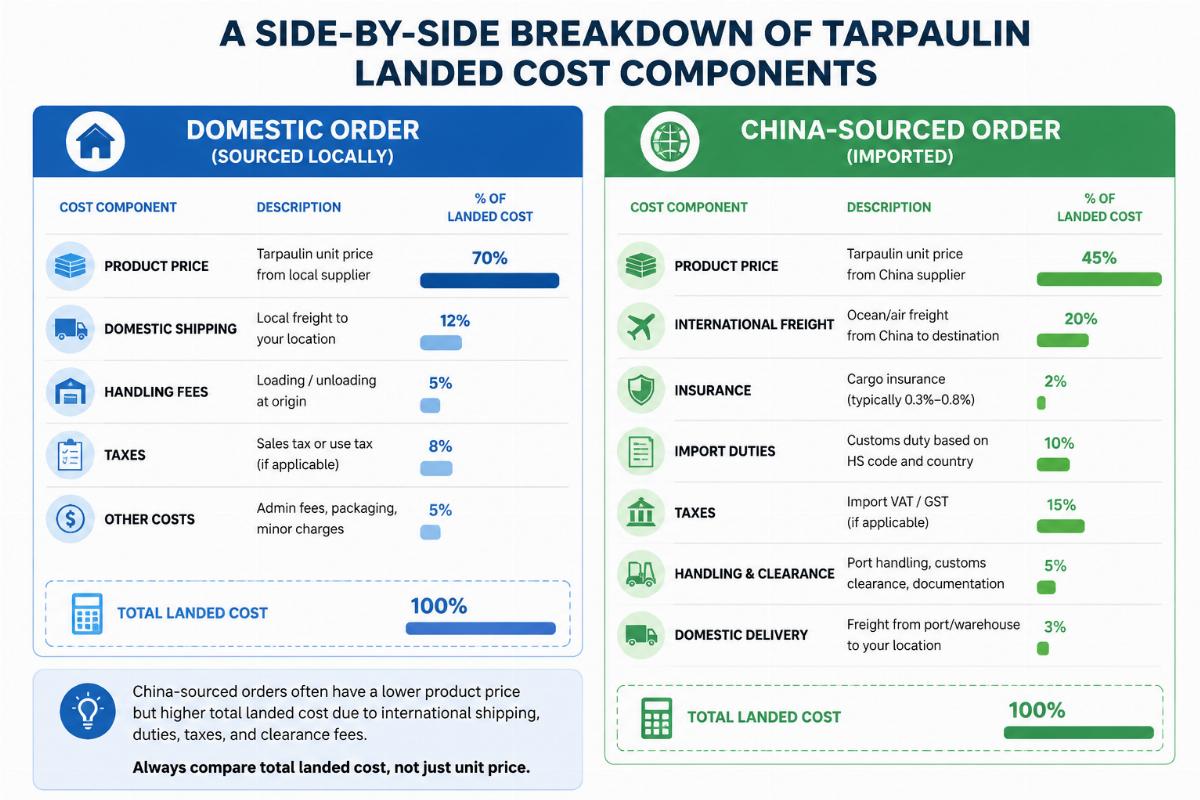
Below we walk through the exact steps to calculate your full, accurate landed cost without hidden surprises.
Why do most importers miscalculate tarpaulin landed cost from China?
Over 70% of first-time importers miss at least 3 hidden cost items during their initial calculation. These unaccounted costs are not listed on standard supplier quotes, and often only appear on final invoices once the shipment is already in transit, leaving buyers with no room to adjust their budgets.
| Cost Calculation Approach | Common Mistake | Correct Practice |
|---|---|---|
| Upfront price comparison | Only review the unit product price provided by the supplier | Map all cost components from factory gate to final delivery location |
| Duty estimation | Use generic product category rates for all tarpaulin types | Match exact product specifications to region-specific HS code schedules |
| Freight budgeting | Assume standard container rates apply to all order sizes | Calculate LCL and FCL options separately based on total shipment volume |
A North American wholesaler recently ordered 12,000sqm of custom weight PVC tarpaulin rolls, and initially projected a 12% cost savings compared to their prior domestic supplier, before realizing they had omitted port handling and customs brokerage fees. After adjusting for those costs and leveraging tiered duty rates for their product category, they ultimately landed a 27% lower total cost with a 14-day container lead time [NEED_CITE: 12,000sqm custom PVC tarpaulin order from a Chinese factory delivered 27% lower total landed cost than prior domestic supplier pricing].
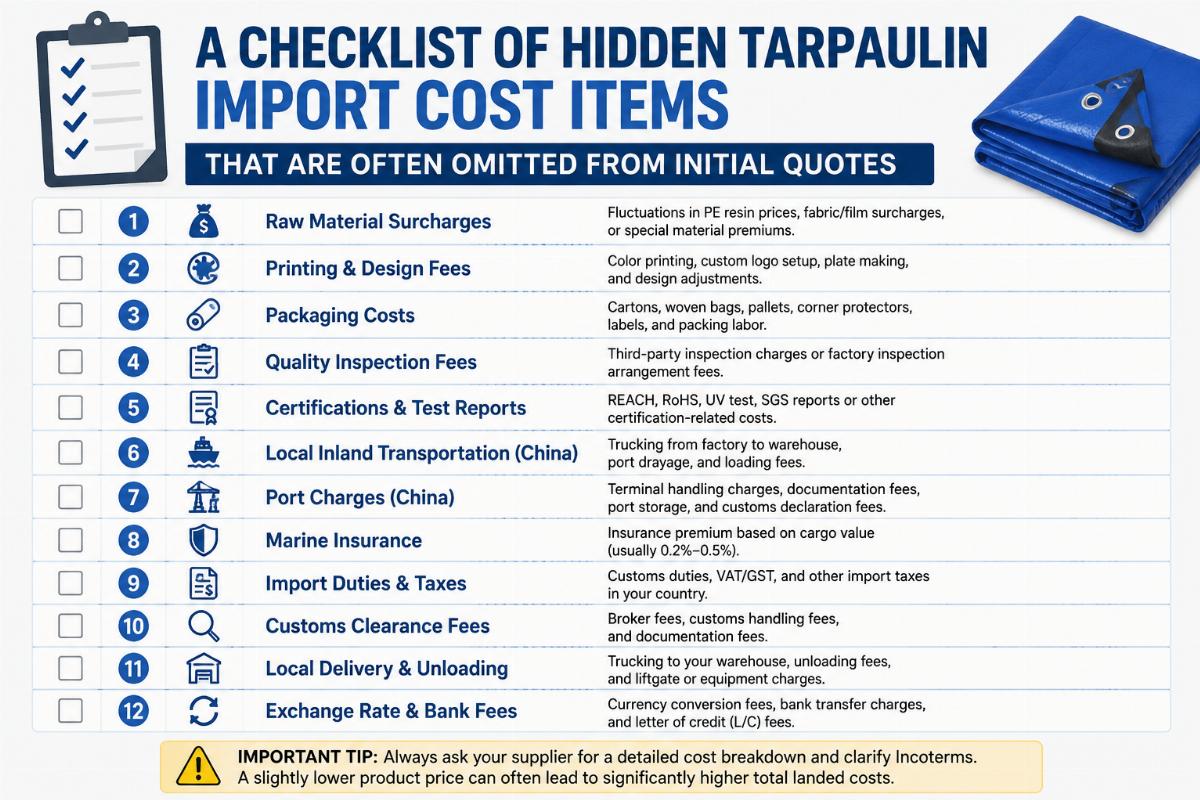
- Factory Gate Cost Confirmation – Request a full line-item quote that includes inland pickup from the factory and pre-shipment inspection fees before locking in pricing.
- HS Code Verification – Cross-reference your product’s material, weight and end use against the latest customs schedules for your target market to confirm the correct duty rate.
- Freight Quote Benchmarking – Get separate quotes for consolidated LCL and full FCL shipping to compare per-unit costs across order volumes.
How to classify tarpaulin products to get the correct applicable duty rate?
Correct HS code assignment for PVC coated, PE woven and canvas tarps cuts unnecessary duty overpayment by up to 12%. Many buyers use a single generic code for all tarpaulin products, but different material types and end uses carry drastically different duty rates across the US, EU and MENA markets.
| Product Type | Common Misclassification | Correct Classification |
|---|---|---|
| PVC coated tarpaulin rolls | Generic fabric category | HS code aligned to coated textile products for industrial use |
| Custom fitted truck tarpaulins | Generic vehicle accessory category | HS code matched to custom cargo protection products |
| Fire retardant construction tarps | Generic construction material category | HS code for fire-resistant temporary site protection materials |
A European logistics firm ordered 320 units of custom fitted heavy duty truck tarpaulin covers last quarter, and initially used a misclassified code that would have resulted in an 8% overpayment on duties. We reclassified the products to match the exact specification for custom cargo covers, and pre-calculated all duty and freight costs to align perfectly with their 45-day project budget.
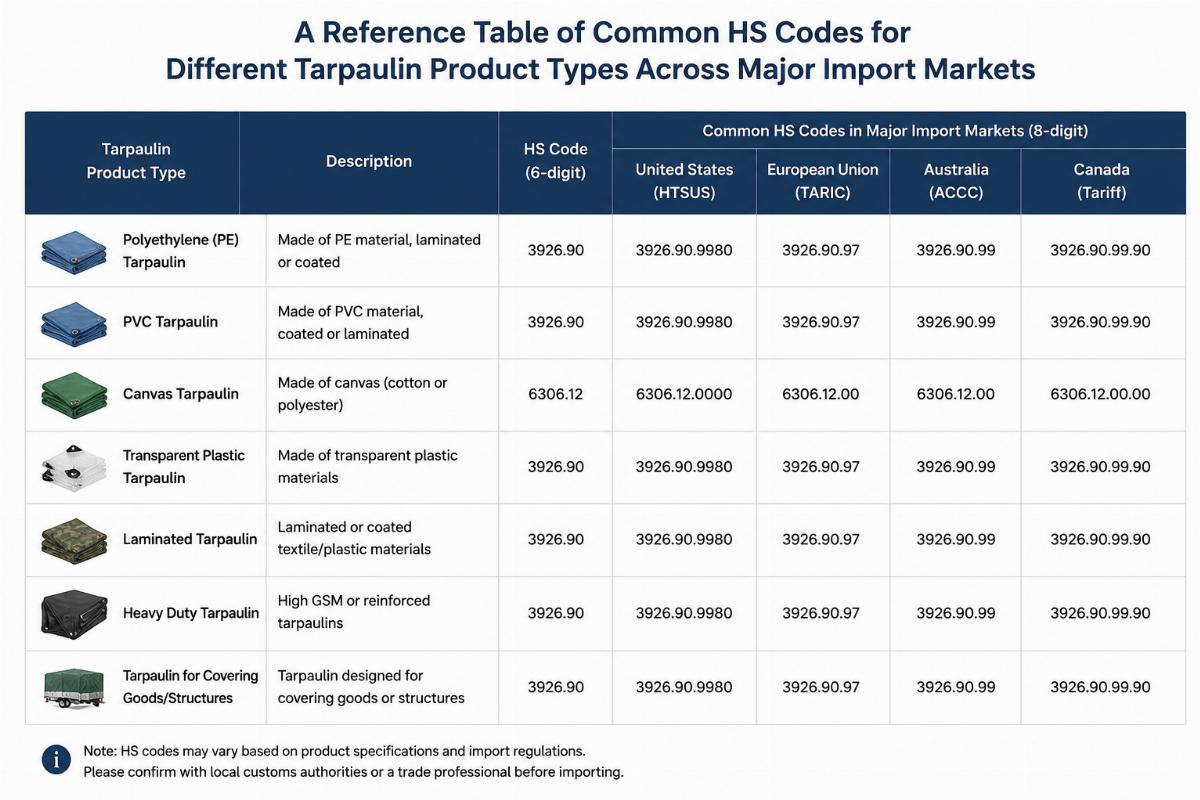
- Product Specification Logging – Document exact material composition, weight per square meter and intended end use before requesting classification guidance.
- Duty Rate Cross Check – Confirm the assigned rate with both your supplier and local customs broker to eliminate conflicting interpretations.
- Classification Documentation – Keep a formal record of the classification rationale to avoid delays or additional duties during customs clearance.
What is the difference between FCL and LCL freight costs for different tarpaulin order sizes?
Order volumes over 18,000sqm get 22% lower per unit freight cost via full container shipping. Consolidated LCL shipping is often assumed to be only for very small orders, but it can deliver competitive rates for mid-sized orders as long as you use a provider that bundles multiple shipments into a single shared container.
| Order Volume | Common Freight Choice | Cost Optimized Choice |
|---|---|---|
| Under 500sqm | Individual small parcel shipping | Shared LCL container with grouped shipments |
| 500sqm to 18,000sqm | Separate LCL shipping per order | Consolidated LCL with pre-negotiated bulk rates |
| Over 18,000sqm | Split LCL shipments to avoid unused space | Full FCL container to lock in lowest per-unit rates |
A Middle East construction contractor sourced 28,000sqm of fire retardant site protection tarps earlier this year, and initially planned to ship the order as two separate LCL consignments. Instead, we structured the shipment as a single consolidated LCL load, which reduced their total freight cost by 18% compared to the original separate shipping arrangement [NEED_CITE: 28,000sqm consolidated LCL tarpaulin shipment cost 18% less than separate individual shipping arrangements].
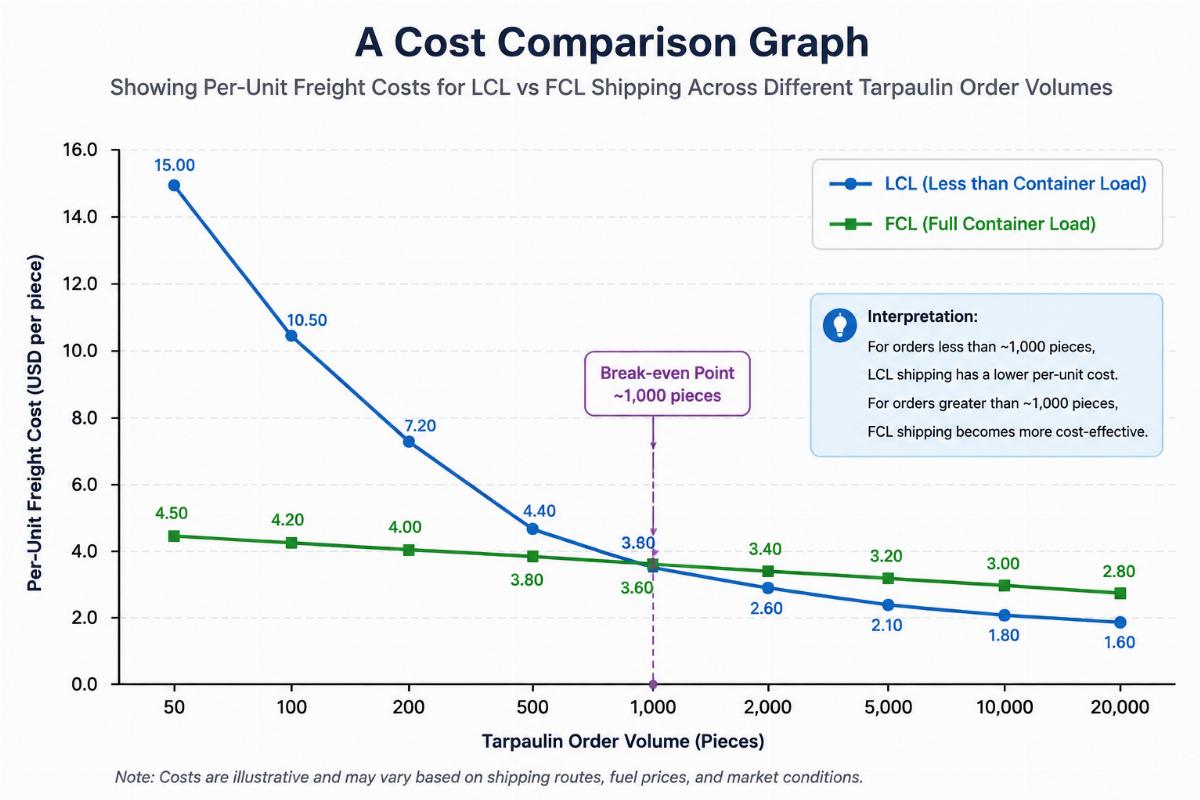
- Volume Calculation – Calculate total shipment volume including packaging to avoid underestimating the space your order will take in a container.
- Consolidation Confirmation – Ask your supplier if they offer shared container access for smaller orders to avoid premium small-shipment fees.
- Final Cost Lock – Confirm all freight surcharges including fuel adjustments and port handling are included in the quoted rate before booking.
How do Chinese tarpaulin suppliers reduce your total landed cost without cutting quality?
Factory direct pricing, no middleman markup and bundled pre shipment inspection deliver consistent long-term cost savings. Many buyers assume lower cost from China means lower quality, but established manufacturers can deliver both lower total cost and consistent quality by eliminating unnecessary layers in the supply chain.
| Supplier Type | Common Cost Structure | Direct Factory Cost Structure |
|---|---|---|
| Middleman trader | 15-25% markup on top of factory pricing plus separate inspection fees | Zero markup, all costs listed directly at the factory level |
| Small uncertified factory | Low base price but high risk of rework and return costs post-delivery | 100% pre-shipment QC that eliminates 9% average post-receipt rework costs [NEED_CITE: 100% pre-delivery inspection eliminates 9% average post-receipt rework and return costs for bulk tarpaulin orders] |
| General trading company | One-size-fits-all MOQ that forces over-ordering to hit rate thresholds | Flexible MOQ terms that match order size to your actual demand |
Shandong Jinxiang, with 30 years of tarpaulin manufacturing experience, ISO and CE certifications, 24-hour quotation response and 7-day sample turnaround, delivers transparent landed cost quoting with no hidden add-ons, aligning with the structure that so many of our long-term buyers rely on for consistent, predictable budgeting.
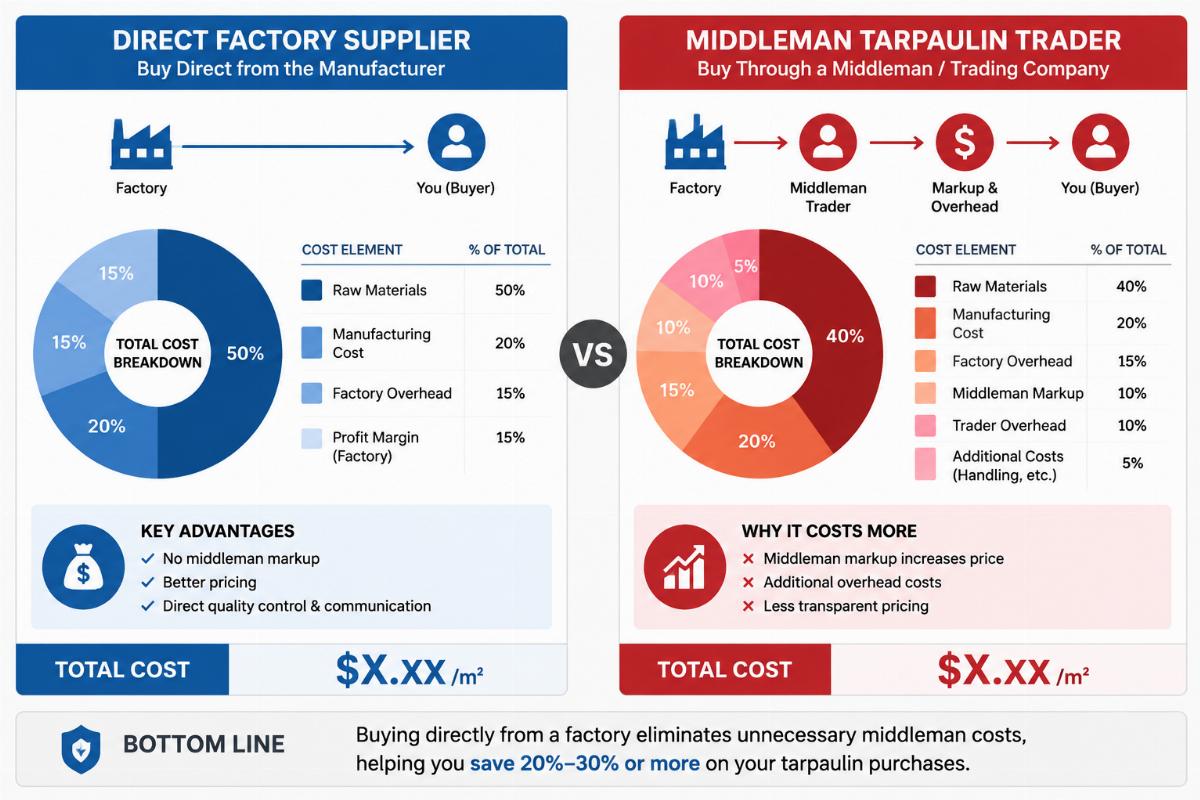
- Middleman Markup Elimination – Prioritize suppliers that provide direct factory quotes with no third-party intermediary fees