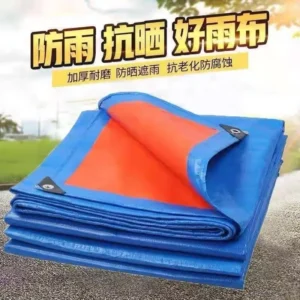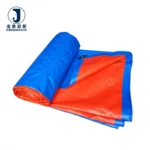
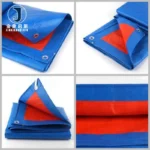
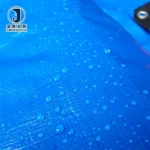
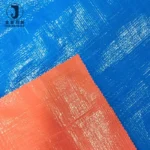

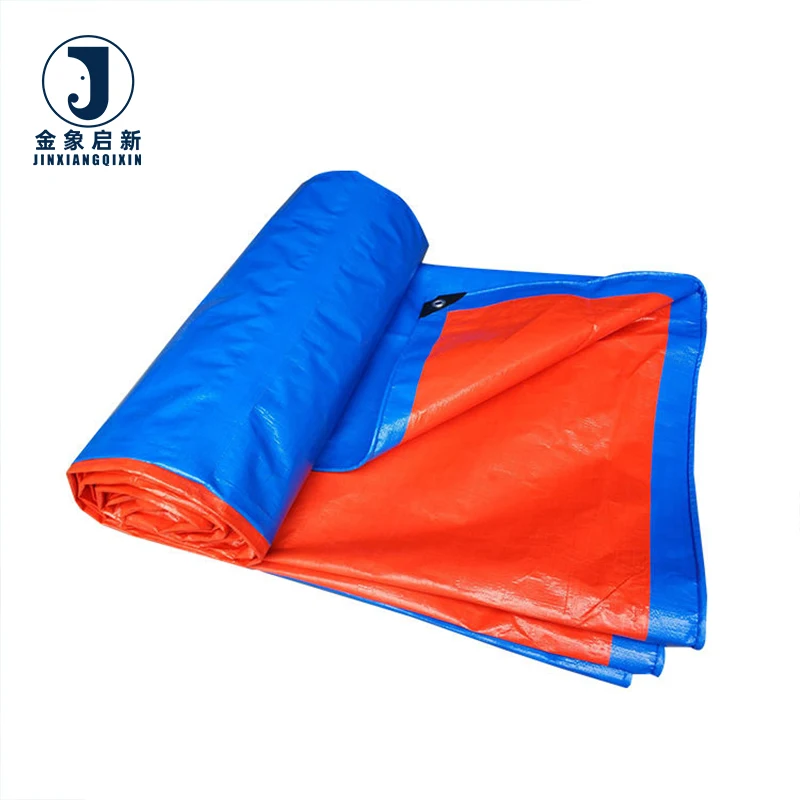
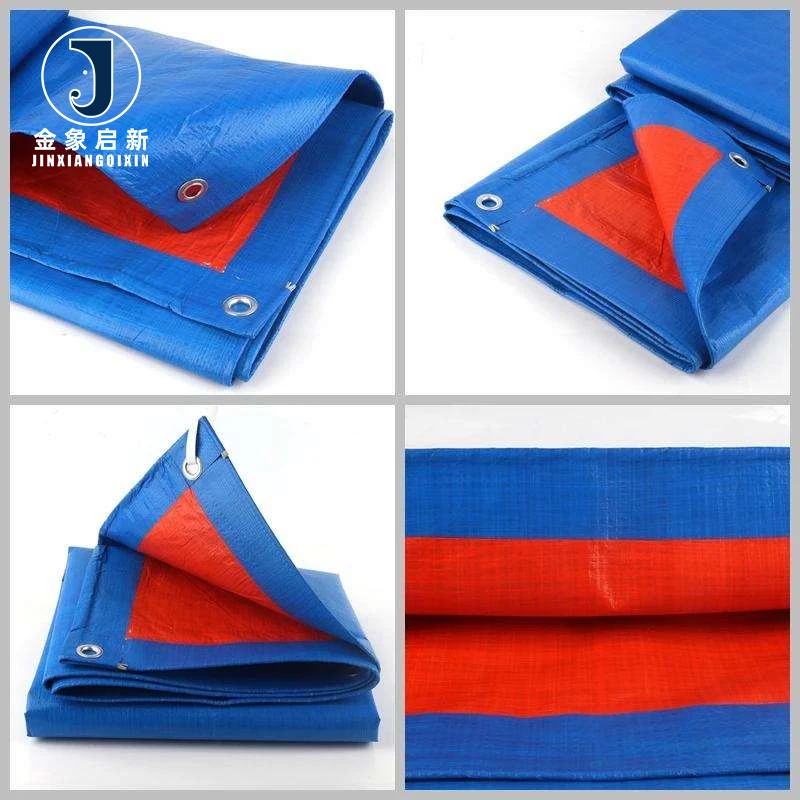
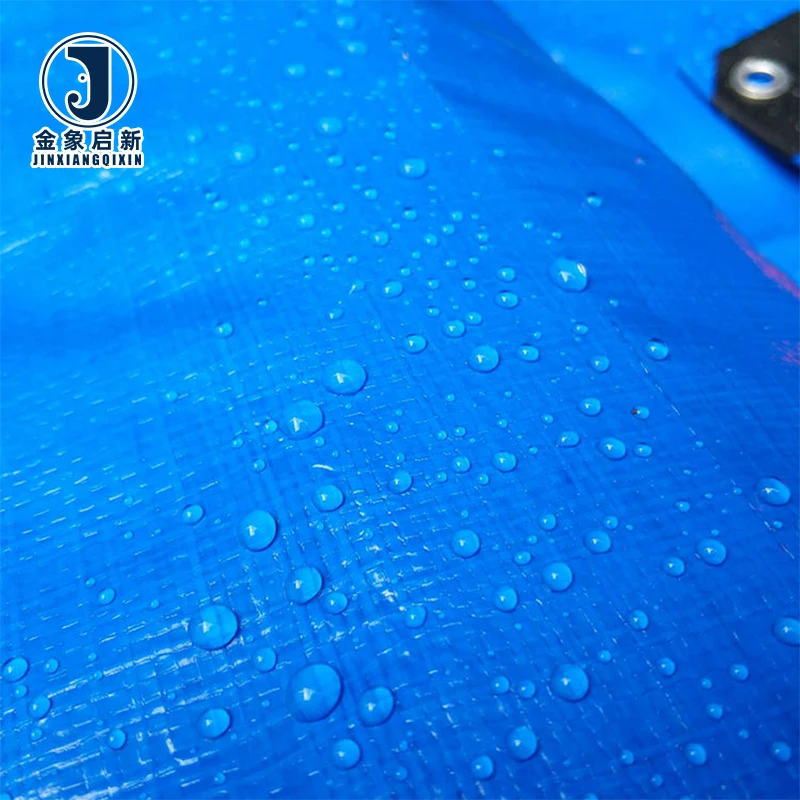
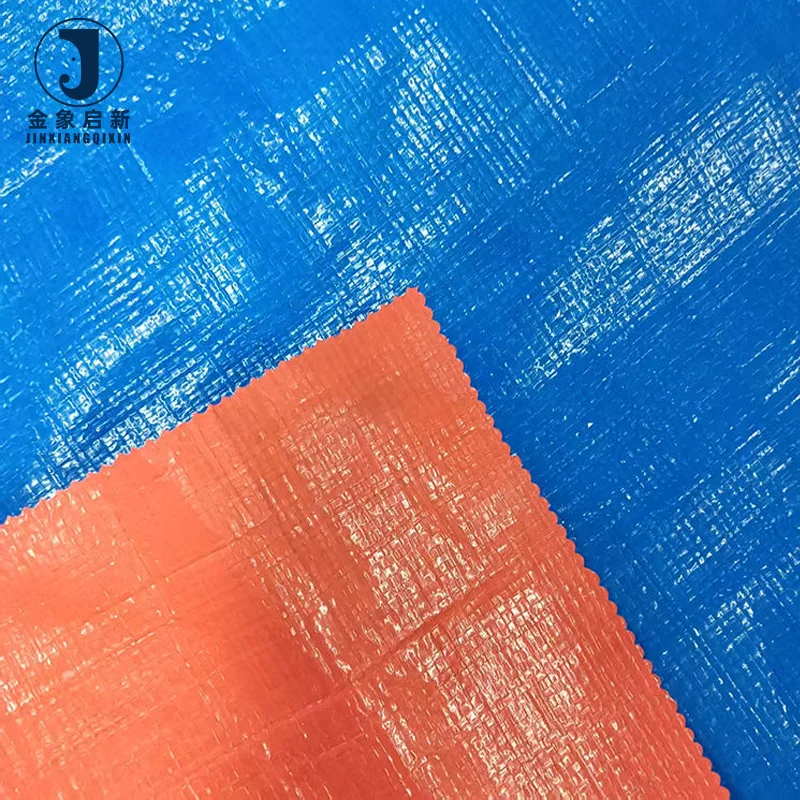
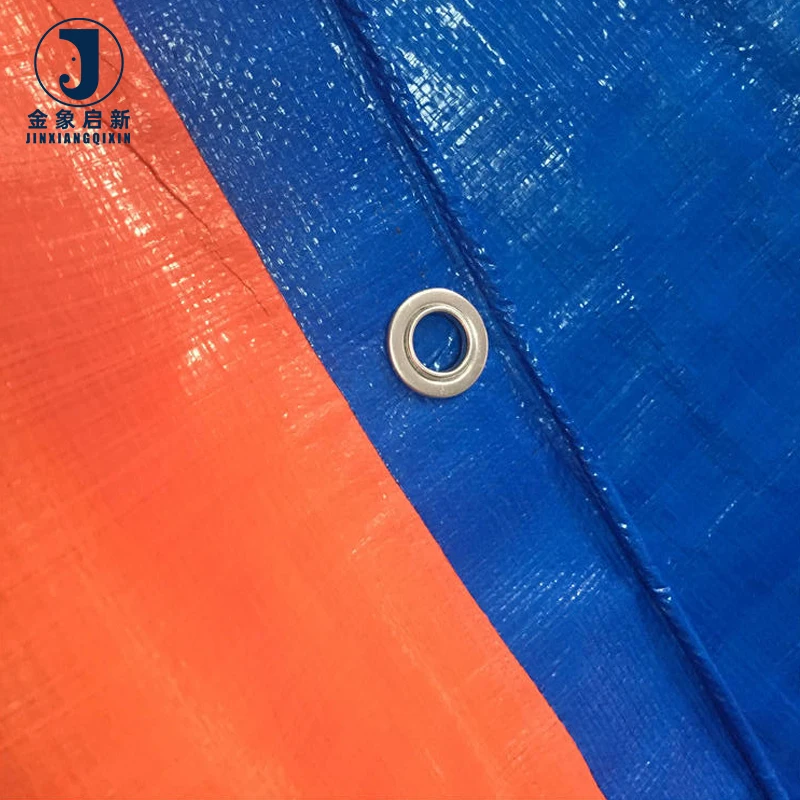
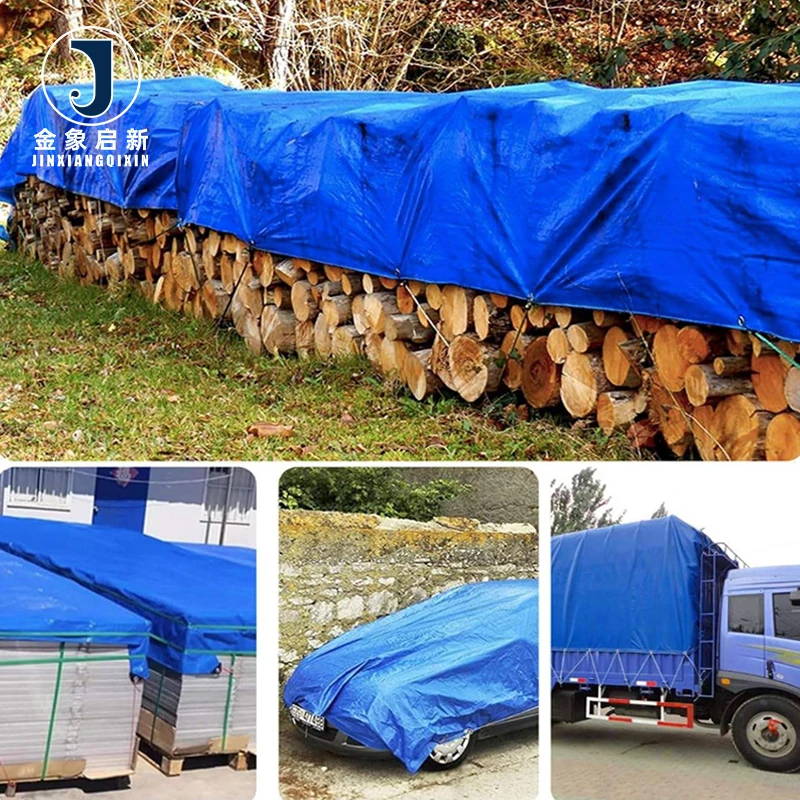
Process-Controlled Coating — our three full production lines manage LDPE coat weight and adhesion on HDPE woven fabric roll-by-roll, so the PE tarpaulin you receive matches the specification you approved.
Technical Specifications
| Parameter | Value |
|---|---|
| Product Type | PE Tarpaulin |
| Material | HDPE woven fabric with LDPE coat on both sides |
| Density (Mesh Count) | 6×6 to 16×16 mesh |
| Weight (GSM) | 50 g/m² to 300 g/m² |
| Color Options | Blue, Orange, White, Black, Grey, Yellow, Green, Red, or custom |
| Printing | Logos or company information available; reinforced strip optional |
| Sheet Size | 2×3, 3×4, 3×5, 4×5, 5×6, 6×8, 10×10, 10×12, 12×14 m, or custom |
| Roll Size | 100 m per roll or custom |
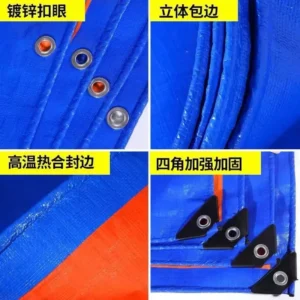
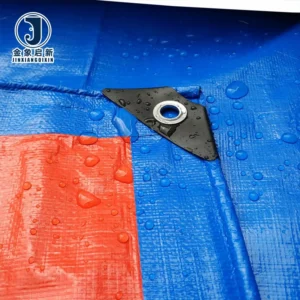
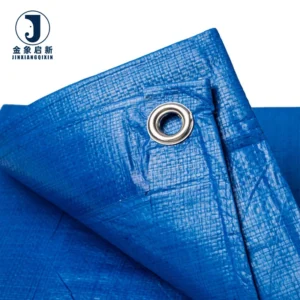
| Edge Making | PP rope hem; plastic triangle corner reinforcement; rustproof aluminum eyelets every 1 m or 1.5 m or custom |
| Special Treatment | Fire resistant / UV protection available on request (grade and test basis to be confirmed per project standard) |
| Standards | ISO, CE (per company profile) |
Application Suitability
| Application | Exposure & Requirement |
|---|---|
| Mine and tunnelling ventilation duct | Continuous airflow pressure, underground fire-risk environment, anti-static compliance mandatory |
| Aviation ground support ventilation | Temporary duct routing on tarmac, fuel-proximate zones, rapid deploy and strike |
| Membrane and inflatable structure fabric | Tensile load from internal air pressure, UV exposure on exterior skin, welded seam integrity |
| Construction site enclosure | Wind load on large panels, abrasion against scaffolding, weather exposure over multi-month projects |
Why a Ventilation Duct Fails When the PE Tarpaulin Lacks Certified Fire-Retardant and Anti-Static Documentation
The duct passes airflow but fails the site inspector’s paperwork check because the fire-retardant or anti-static grade was never tied to a recognised standard.
Mining and tunnelling projects demand documented compliance before any duct is hung underground. When a fire retardant PE tarpaulin arrives without a test report citing a specific standard such as M2, NFPA 701, or DIN 4102, the safety officer has no basis to approve it. The duct is stripped out and replaced, costing the contractor both material and downtime [NEED_CITE: fire classification standards for underground ventilation materials]. The same logic applies to anti-static requirements — surface resistance must be measured and reported against a documented method, not simply stated as a feature on the quotation.
Aligning the Duct Fabric to Airflow and Structural Demands
Selecting the right PE tarpaulin for ventilation duct construction starts with matching mesh density to the airflow resistance the system can tolerate. A 6×6 mesh offers lower resistance for long-run mainline ducts, while a 16×16 mesh provides higher tensile stability where the duct flexes at bends and junctions. The HDPE woven base with LDPE double-side coating gives the fabric enough body to hold a round or flat duct profile under negative and positive pressure cycles without collapsing or ballooning.
Managing Fire-Retardant and Anti-Static Compliance at Specification Stage
Any fire retardant PE tarpaulin intended for underground or enclosed-space ventilation must carry a test report that names the exact standard the project specification calls for. Available in fire resistant grades — confirm the grade required for your market and the testing body accepted by the site authority. Anti-static treatment follows the same principle: surface resistance measurement must reference a recognised method, and the report must accompany the shipment so the safety inspector can file it without delay [NEED_CITE: anti-static surface resistance test methods for mining ventilation fabrics].
Reading the Specification Sheet Beyond GSM Alone
Weight in g/m² tells you how much material is present, but it does not tell you how that material is distributed between the HDPE base fabric and the LDPE coating. A 180 g/m² PE tarpaulin woven at 14×14 mesh with a lighter coat will behave differently under tensile load than the same weight woven at 8×8 with a heavier coat. The mesh count determines how many yarns share the load in each direction, while the coating weight governs waterproofing, weldability and surface protection. Choosing the correct balance depends on whether the duct will be welded or sewn, and whether it must resist abrasion against tunnel walls or simply contain airflow in a suspended run [NEED_CITE: relationship between mesh count and tensile performance in woven coated fabrics].
What Happens When the Wrong Grade Reaches the Site
A duct fabricated from material that lacks the specified fire-retardant grade is not a marginal failure — it is a compliance failure that halts the entire ventilation installation. The contractor must remove the duct, source replacement fabric, and re-fabricate under project deadline pressure. Colour variation between rolls can also force rejection when sections of duct installed side by side show visible differences, even though the primary function is airflow containment rather than aesthetics. Welded seams failing before the fabric itself is another consequence of selecting a coating formulation that does not match the thermal parameters of the fabrication equipment [NEED_CITE: common causes of welded seam failure in coated polyethylene fabrics].
Why Sourcing the Duct Fabric Here Reduces Specification Risk
Deep process control over LDPE coating weight and adhesion means each roll of PE tarpaulin leaves the line with consistent coat distribution, which directly supports reliable heat-weld parameters during duct fabrication. Three full production lines and 36 sets of professional equipment provide the capacity to fulfil bulk duct orders within project timelines. A 10-person R&D team handles material selection and sample development so you can verify weld behaviour and airflow characteristics before committing to production volume. Dedicated QA/QC at every production stage with full pre-shipment inspection catches GSM deviation, mesh count variation, and coating inconsistency before the rolls are packed. Custom roll lengths up to 100 m reduce splice joints in continuous duct runs, improving both airflow efficiency and structural continuity.
Documentation & Verification
- Material specification sheet stating base fabric denier, mesh count, LDPE coating weight and GSM for each batch
- Fire-resistant test report citing the specific standard required by the project authority
- Anti-static surface resistance measurement with documented test method where applicable
- Pre-shipment inspection record verifying GSM, mesh count and coating consistency roll-by-roll
- ISO and CE certificates supporting export compliance documentation
- Roll packing list with gross and net weight per roll for container loading planning
Fabrication, Handling & Storage
- Set heat-weld temperature and dwell time to match the LDPE coating thickness on the selected GSM grade
- Space aluminum eyelets at 1 m intervals on heavy-duty grades to distribute tie-down load across the PP rope hem
- Store rolls upright on pallets to prevent flat-spotting and crease marks on the LDPE coated surface
- Allow cold-stored PE tarpaulin rolls to reach ambient temperature before unrolling to avoid coating crack at low temperature
- Use mild detergent and soft brush for cleaning; avoid solvent-based agents that may degrade the LDPE coat
- Plan duct panel cutting layout to maximise yield from 100 m roll length and minimise transverse weld joints
Starting the Specification Conversation
Provide the ventilation duct diameter or flat width, the total linear meter requirement, and the fire-retardant or anti-static standard your project specification mandates. Confirm whether you need rolls for in-house fabrication or finished duct sections with welded seams and flange connections. If the installation environment involves chemical exposure or extreme temperature ranges, share those conditions so the correct LDPE coating formulation and HDPE base fabric density can be recommended.
Frequently Asked Questions
Q: Which fire-retardant standard applies to my mine or tunnel ventilation duct project?
A: The required standard depends on the country and the site operator’s safety specification. Common references include M2, NFPA 701, and DIN 4102. Share your project specification document so the correct fire retardant PE tarpaulin grade can be matched and a test report from a recognised laboratory can be arranged before production begins.
Q: How is anti-static compliance documented for underground PE tarpaulin duct use?
A: Anti-static treatment is applied during the LDPE coating stage and verified by surface resistance measurement. The test report states the measured value and the method used. Provide the anti-static requirement from your site safety standard so the correct treatment grade and documentation can be prepared for your anti-static certified PE tarpaulin order.
Q: How do I confirm the GSM of PE tarpaulin rolls on arrival matches the quotation?
A: Request the pre-shipment inspection record that lists measured GSM per roll. On receipt, cut a measured sample from each roll, weigh it, and calculate g/m². Any deviation beyond the agreed tolerance should be reported immediately with photos and sample reference numbers for resolution.
Q: What roll length and width should I choose for continuous ventilation duct fabrication?
A: Longer rolls reduce transverse splice joints, improving airflow smoothness and structural continuity. Standard roll length reaches up to 100 m. Width should match the duct circumference plus weld overlap. Discuss your duct diameter and fabrication method so the correct ventilation duct fabric roll dimension can be recommended.
Q: What seam method works best for PE tarpaulin duct construction under flex and airflow pressure?
A: Heat welding fuses the LDPE coating layers into a continuous bond, typically outperforming sewn seams in air-holding ability. Sewn seams with taped overlap are used where field repair is expected. The choice depends on duct pressure rating, installation environment, and whether the duct will be relocated frequently during project phases.