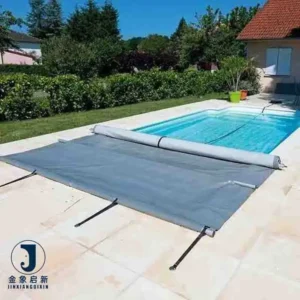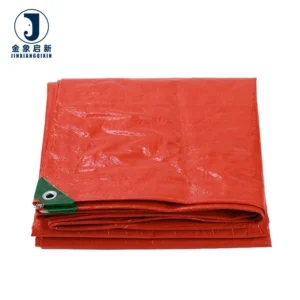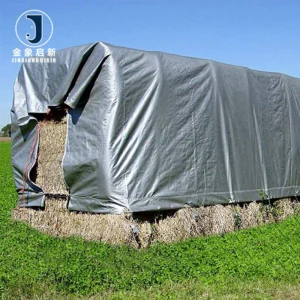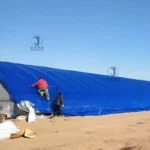
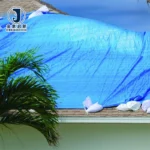
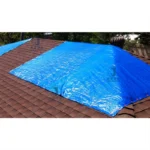
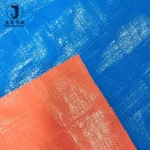
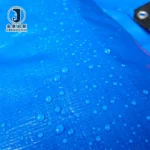
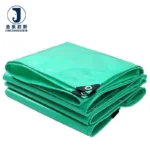
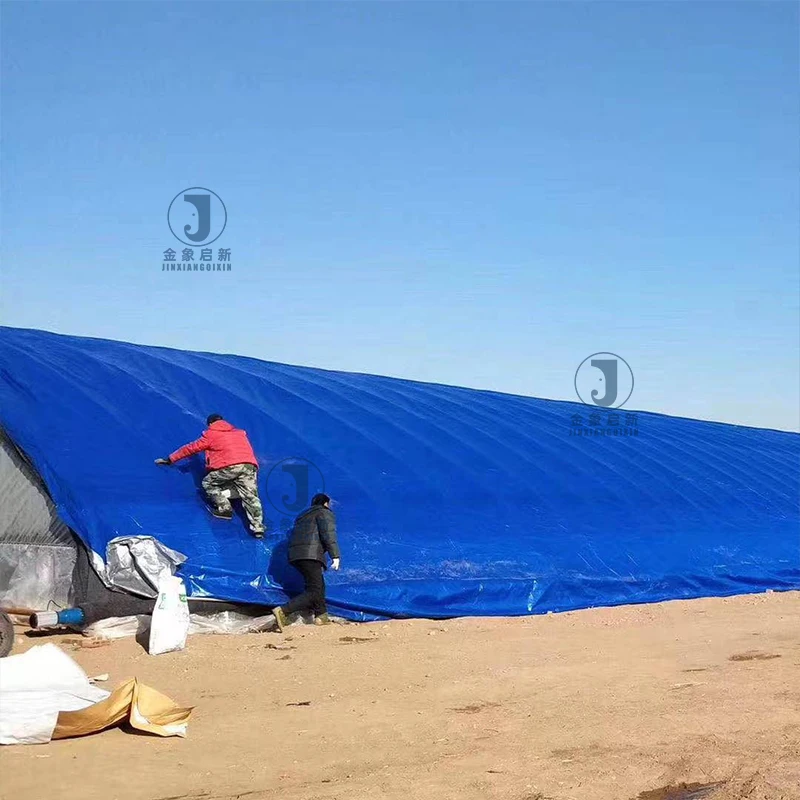

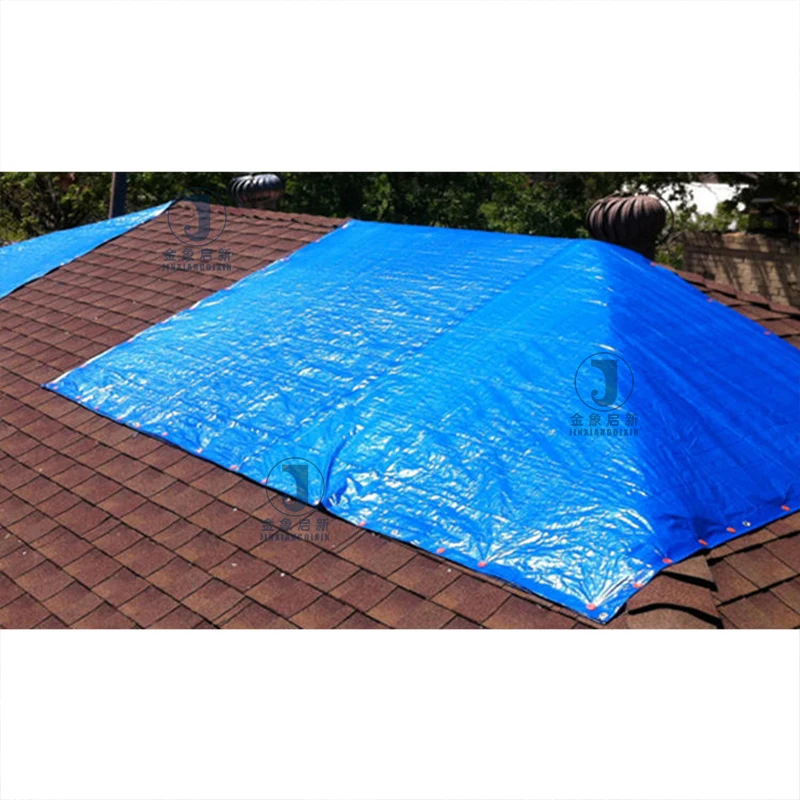
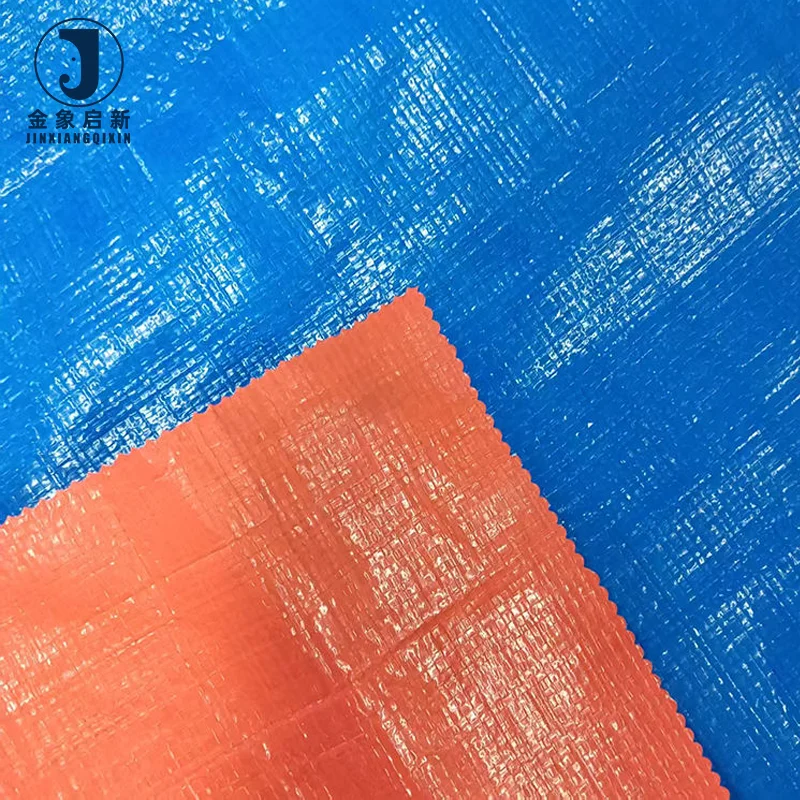
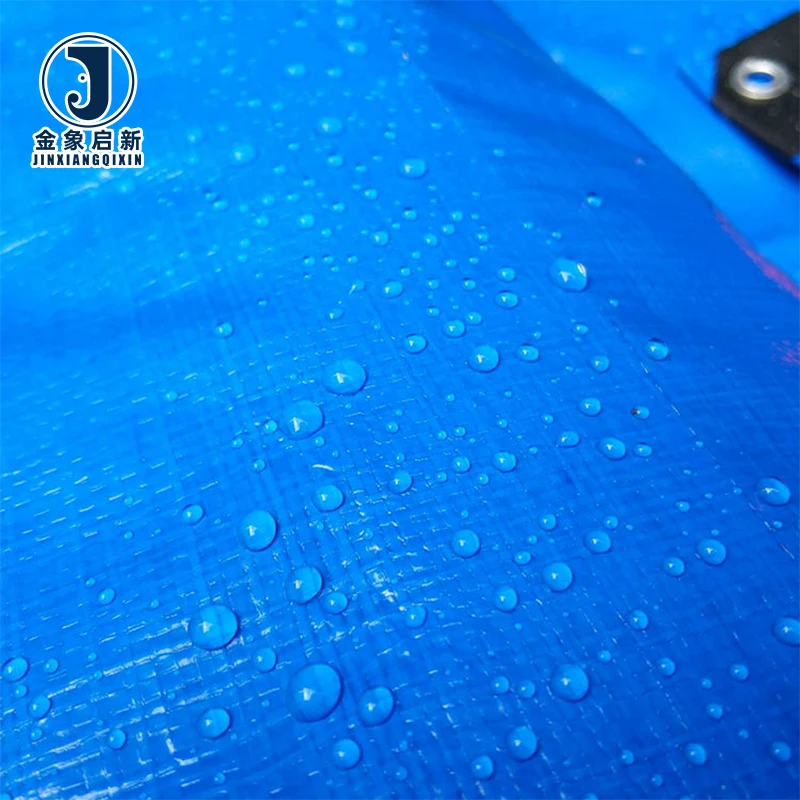
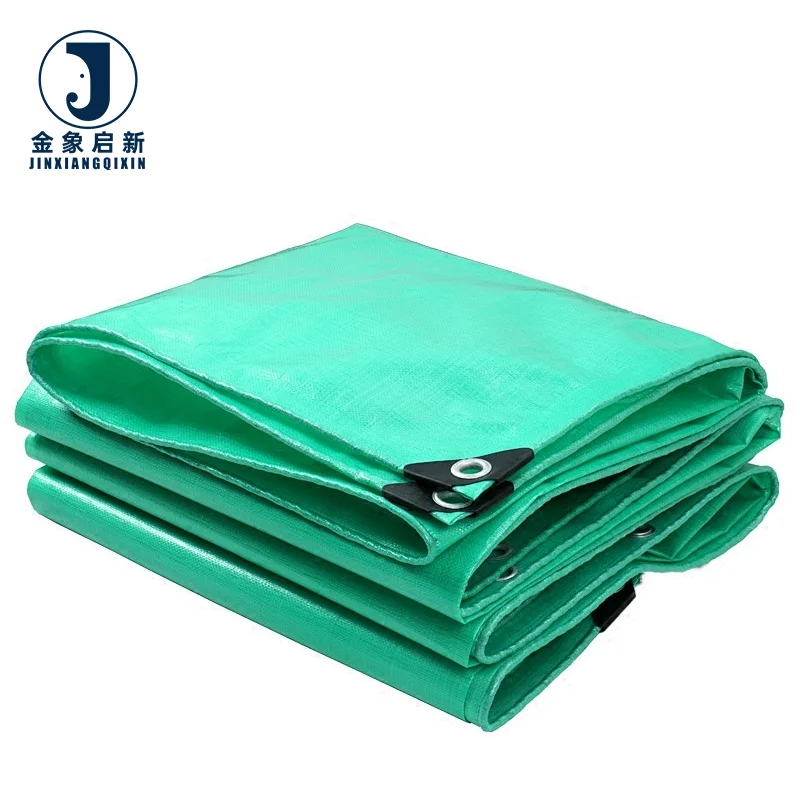
Deep Coating Process Control — Every roll of PE tarpaulin passes through in-process QA checks on coating weight and adhesion before leaving the production line.
Technical Specifications
| Parameter | Value |
|---|---|
| Product Type | PE Tarpaulin |
| Material Construction | HDPE weaving with LDPE lamination on both sides |
| Weight Range | 50 g/m² – 220 g/m² (confirm grade for your application) |
| Total Thickness | 0.2–0.4 mm (8–16 mil) |
| Mesh Count Options | 6×6, 6×7, 7×7, 7×8, 8×8, 9×9, 8×10, 10×10, 12×12, 14×14, 14×16 |
| Roll Width Options | 6 ft, 8 ft, 10 ft, 12 ft / 2 m, 4 m, 6 m |
| Roll Length Options | 100 yards, 100 meters, or custom |
| Finished Size Options | 2×2 m through 8×10 m (and corresponding imperial sizes) |
| Colour Options | Blue, Blue/Orange, Green, Grey, Black, Clear, Grey/Green, Orange, or custom |
| Edge Reinforcement | PP rope in hem on all four edges |
| Eyelet Spacing | Galvanized eyelets every 3 ft or 1 m |
| Corner Reinforcement | Reinforced plastic corners |
| UV Treatment | Available (test basis not stated — confirm duration for your exposure conditions) |
| Flame Retardant | Grade not stated — confirm availability for regulated sites |
| Anti-Static | Not stated — verify certification if required |
| Key Features | Waterproof, washable, tear resistant, mildew proof, anti-aging |
Application Suitability
| Application | Exposure & Requirement |
|---|---|
| Mining and tunnelling site covers | Moisture ingress, abrasion from aggregate, mechanical handling of heavy stockpiles |
| Construction scaffolding wraps | Wind loading, scaffold tube abrasion, UV exposure over multi-month builds |
| Truck and trailer load covers | Road debris impact, tie-down tension at eyelet points, weather during transit |
| Agricultural stockpile covers | Rain and ground moisture, UV exposure during seasonal storage, mildew in humid climates |
| Industrial ground sheets | Puncture from equipment tracks, chemical splash from site operations, repeated repositioning |
Why PE Tarpaulin GSM Alone Does Not Guarantee Site Compliance
A heavier sheet only protects your load if the weave density, lamination bond, and edge reinforcement match the actual forces on the job.
Ventilation duct and specialist structure contractors often specify PE tarpaulin covers for temporary enclosures on regulated sites, only to discover that the fire-retardant or anti-static certification required by local safety codes was never available on the material they received. [NEED_CITE: fire safety classification requirements for temporary site enclosures and ground protection sheets] The consequence is not a delayed shipment — it is a halted project while replacement material is sourced and inspected. Weight and weave density define mechanical behaviour, but compliance defines whether the material is permitted on site at all.
Mesh Density and Load-Bearing Behaviour Across the GSM Spectrum
The weave structure of this PE tarpaulin ranges from a 6×6 open mesh at the lower GSM grades to a tight 14×16 weave at the upper end, and this density progression directly governs how the material distributes point loads. At scaffolding wrap or truck cover scale, a loosely woven base concentrates stress at individual yarn crossings, making the sheet more vulnerable to tear propagation at tie-down points. Denser weaves spread the same tie-down force across more intersections, which is why the eyelet spacing and edge reinforcement specification must be read together with the chosen mesh count.
Lamination Adhesion and Waterproof Integrity Under Field Conditions
Double-side LDPE lamination over an HDPE woven base creates a waterproof barrier, but the bond between coating and substrate determines whether that barrier survives repeated folding and repositioning on site. [NEED_CITE: peel strength test methods for laminated woven fabrics per ISO standards] When the lamination delaminates at a fold line, moisture penetrates the exposed HDPE weave and the sheet loses both its waterproof function and a portion of its tear resistance. Selecting the correct GSM grade for the expected handling frequency is as important as the waterproof rating itself.
Reading Weave Count, GSM, and Thickness Together
Three numbers define the mechanical character of any PE tarpaulin roll: mesh count, weight per square metre, and total thickness. Mesh count describes how many HDPE yarns cross in each direction per unit area — a 14×16 weave has substantially more intersections than a 6×6, giving the denser fabric greater resistance to tear propagation. GSM reflects the combined mass of the woven base and both lamination layers, so two sheets at the same GSM can have very different base-to-coating ratios. Thickness, measured here at 0.2–0.4 mm, correlates with puncture resistance but does not independently predict tensile strength — a thin, densely woven sheet can outperform a thicker, loosely woven one under sustained tension. Understanding all three values together prevents over-specifying thickness while under-specifying the weave density that actually carries the load.
The Hidden Cost of Underspecified Material on Specialist Sites
When a PE tarpaulin grade is chosen on price per roll rather than matched to the exposure conditions, the failure rarely appears on day one. A sheet covering a mining stockpile may hold through a dry season and then succumb to mildew-driven degradation once humidity rises, because the anti-aging treatment was not specified for that climate. On a construction site, a loosely woven ground sheet can puncture under tracked equipment within the first week, forcing a full replacement mid-project. [NEED_CITE: field failure patterns in temporary site protection materials] These are not warranty claims — they are schedule disruptions that cost far more than the material price difference between grades.
Production Discipline Behind Every Shipped Roll
Three full production lines and 36 sets of professional equipment allow this facility to maintain PE tarpaulin output volume without sacrificing per-roll consistency. A dedicated 10-person R&D team handles material grade selection and sample development, so custom width, colour, and mesh count requests are developed and validated before full production runs. Every roll undergoes in-process QA at each stage — from weaving tension checks through lamination temperature monitoring — with 100% pre-shipment inspection against the stated specification. Samples are developed within days for custom requirements, giving buyers a physical reference to approve before container quantities are committed.
Documentation & Verification
- Material specification sheet stating exact GSM, base fabric weave count, and lamination weight for the selected grade
- UV treatment test report or stated test duration where applicable for outdoor exposure claims
- Flame-retardant and anti-static certification documentation — confirm availability for regulated site requirements
- Pre-shipment inspection record with roll-to-roll colour and weight consistency verification
- ISO and CE certificates with certificate of origin and customs documentation support
Fabrication, Handling & Storage
- Heat welding parameters must match the LDPE lamination thickness to avoid burning through the HDPE base fabric
- Galvanized eyelet placement at 3 ft or 1 m intervals requires reinforced plastic corners at high-tension attachment points
- Store PE tarpaulin rolls upright on hard paper tubes to prevent flat-spot creasing in the woven base
- Allow folded finished tarps to relax and flatten before tensioning across scaffolding or load frames
- Clean with mild detergent only — aggressive solvents can degrade the LDPE lamination bond
- Overlap seams by minimum 150 mm when joining multiple sheets to maintain waterproof continuity
What to Include in Your Enquiry
Provide the specific site exposure conditions — moisture levels, expected UV duration, and any fire or static compliance codes that apply — so the correct grade and treatment package can be matched. Confirm whether roll stock or finished cut-to-size tarps are required, along with the target mesh count, colour, and annual volume. Requesting a pre-production sample for approval eliminates specification gaps before bulk commitment.
Frequently Asked Questions
Q: How do I verify the GSM of PE tarpaulin rolls on arrival matches the quotation?
A: Cut a measured sample from each received roll, weigh it on a calibrated scale, and compare the result to the stated GSM on your material specification sheet. Discrepancies exceeding a small tolerance should be flagged before installation. The pre-shipment inspection record provided with your order documents the weight check performed at the factory.
Q: What documentation supports the UV treatment claim for outdoor exposure?
A: UV treatment is available across the GSM range, but the specific test basis and exposure duration must be confirmed for your project. Request the test report corresponding to the selected grade before specifying the material on long-term outdoor applications. Without a stated test duration, the UV claim remains unverified for your climate conditions.
Q: Is flame-retardant or anti-static certification available for regulated mining and tunnelling sites?
A: The current specification does not state a flame-retardant grade or anti-static rating for this PE tarpaulin product. If your site requires compliance with specific fire safety or static dissipation standards, confirm certification availability before placing the order. Alternative specialist grades may be required to meet regulated site demands.
Q: What roll widths and lengths are available for container loading efficiency?
A: Roll widths from 2 m to 6 m and lengths of 100 yards or 100 metres are standard, with custom lengths available. Container loading varies by packing method — by roll, bale, or carton — and the chosen packing format affects both tonnage and cubic utilisation. Confirm your preferred format during quotation to optimise container space.
Q: How should edge reinforcement and eyelet spacing be specified for heavy-duty attachment?
A: All four edges are reinforced with PP rope in the hem, and galvanized eyelets are placed at 3 ft or 1 m intervals. For applications with high tie-down tension, the reinforced plastic corners provide additional load distribution at the points most likely to experience concentrated stress. Specify your tie-down pattern when ordering to align eyelet positions with your hardware layout.