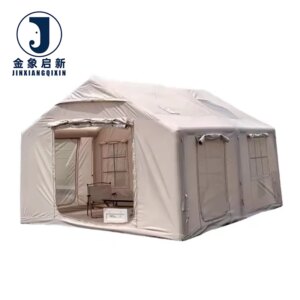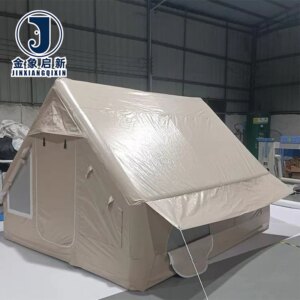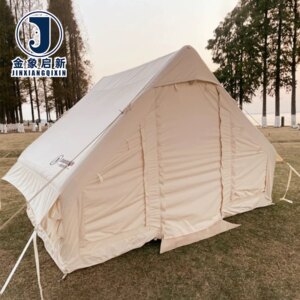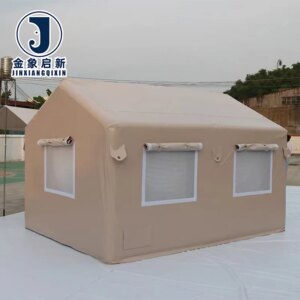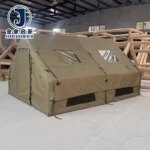
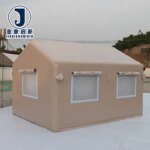

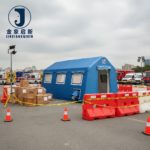
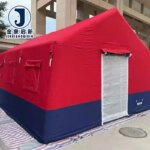
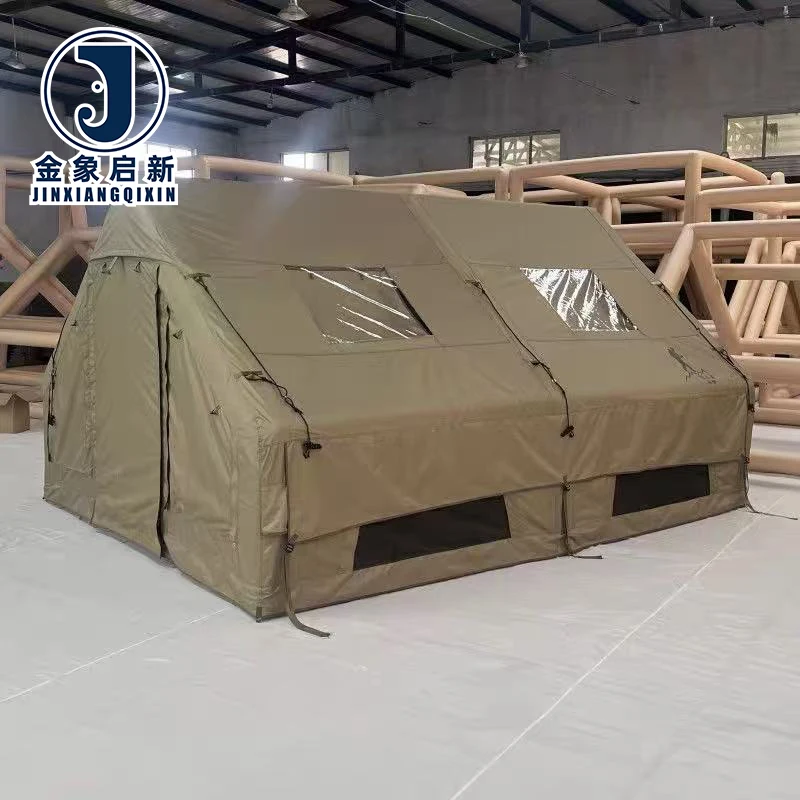
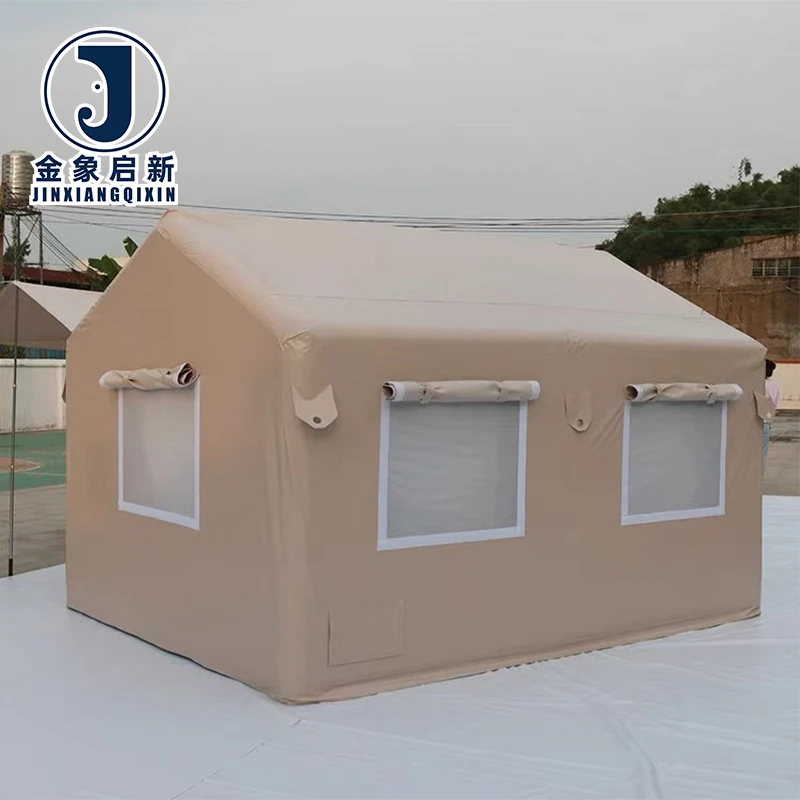
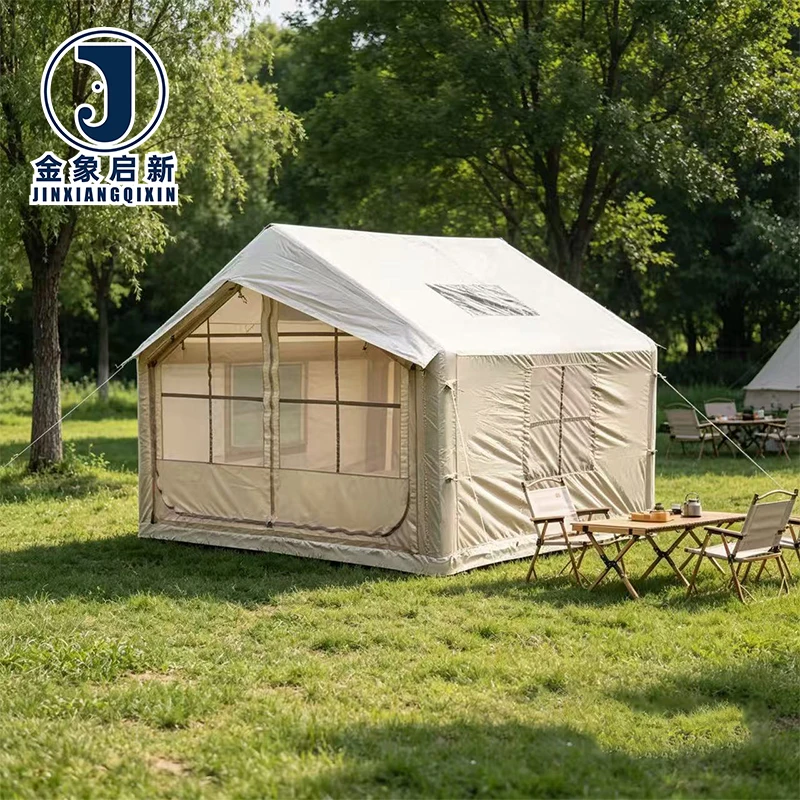
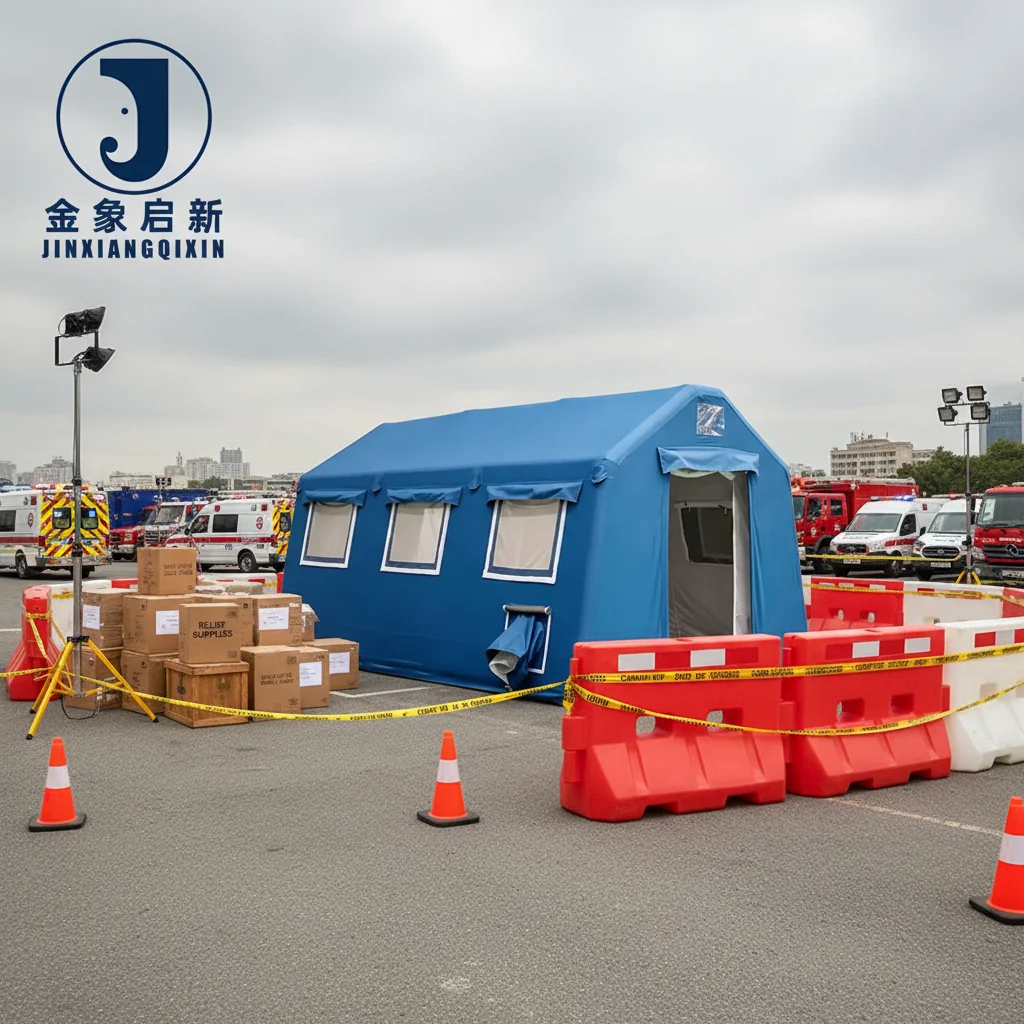
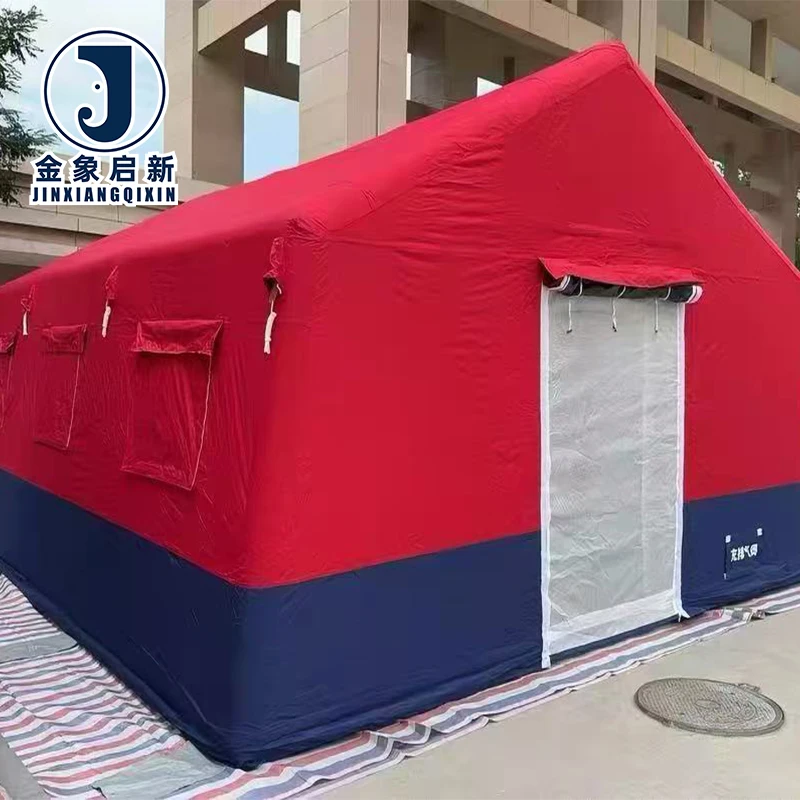
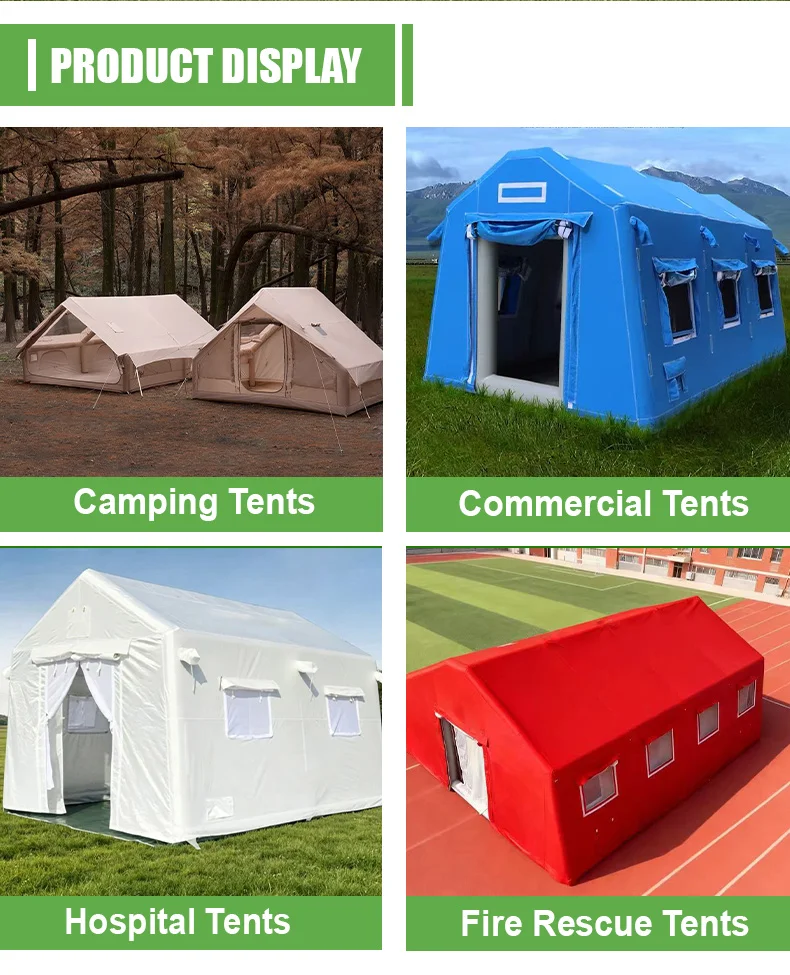
Batch-Consistent PVC Coating — Our in-process QA system verifies colour and coating weight across every roll, eliminating panel-to-panel mismatch on large inflatable deployments.
Technical Specifications
| Parameter | Value |
|---|---|
| Product Type | Inflatable Tent |
| Core Material | PVC Tarpaulin |
| Construction | Single-layer inflatable structure |
| Key Performance | Waterproof, UV-Resistant (test basis not stated in source), Tear-Resistant |
| Deployment | Quick automatic opening |
| Customization | OEM & ODM, sample customization, pattern printing |
| Quality Control | Full-process QA & QC, 24-hour inflation test per unit, high-frequency welding with airtight seam monitoring |
| Certifications | ISO9001, ISO14001, ISO45001, CE |
Application Suitability
| Application | Exposure & Requirement |
|---|---|
| Remote construction site offices | Wind loading, dust ingress, repeated inflation cycles, UV exposure on open terrain |
| Disaster recovery equipment storage | Rapid deployment under time pressure, ground moisture, handling abrasion |
| Infrastructure maintenance command centers | Frequent relocation, temperature fluctuation, need for certified material documentation |
| Temporary logistics warehousing | High-volume footprint, forklift proximity, weather protection for staged goods |
| Commercial emergency preparedness | Long-term storage followed by instant deployment, compliance audit trails |
Why Specified Weight and Coating Adhesion Determine Inflatable Tent Lifespan
A shelter that deflates at the seam is a failed shelter, regardless of how strong the fabric is.
When sourcing an Inflatable Tent manufacturer for project deployment, buyers often focus on the stated GSM of the PVC tarpaulin. But an inflatable structure lives and dies at its welded seams. If the coating does not bond cleanly under high-frequency welding, the seam splits before the fabric reaches its tensile limit [NEED_CITE: tensile and tear test methods for coated fabrics per ISO 1421]. I have seen heavy-grade coated rolls fail at the weld line while lighter materials with consistent coating adhesion held through seasons of inflation cycles. The variable that matters is not weight alone — it is how predictably the coating behaves when subjected to heat and pressure during fabrication.
Single-Layer PVC Construction for Rapid Field Deployment
The single-layer inflatable design reduces packed weight and volume compared to multi-layer alternatives, which matters when shelters must be airlifted or carried into areas with limited vehicle access. Our custom Inflatable Tent production starts with PVC tarpaulin selected for balanced tensile properties across warp and weft, ensuring the structure inflates evenly without localized stress concentrations. Quick automatic opening means a single operator can have the shelter standing in minutes — a critical factor during disaster recovery or time-sensitive site mobilization.
High-Frequency Welding and the 24-Hour Inflation Verification
Every finished unit undergoes a 24-hour inflation test before dispatch. This is not a spot check — it catches micro-leaks at valve junctions and seam intersections that a brief pressure test would miss. High-frequency welding fuses the PVC coating layers at a molecular level, producing airtight seams that resist the repeated stress of inflation and deflation cycles [NEED_CITE: high-frequency welding parameters for airtight PVC seams]. Our 36 sets of professional processing equipment allow parallel production across multiple custom Inflatable Tent orders without sacrificing individual unit verification.
Understanding PVC Tarpaulin Behaviour in Inflatable Applications
The PVC tarpaulin used here relies on coating adhesion and base fabric weave to deliver its waterproof and tear-resistant performance. A tighter weave in the base fabric restricts tear propagation — when a puncture occurs, the surrounding yarns absorb the load rather than letting the tear run. Coating weight influences how well the material seals during high-frequency welding; too little coating and the weld starves, too much and the excess material interferes with seam geometry. UV-resistant formulation is available — confirm the test basis and exposure classification required for your deployment climate before specification. The single-layer construction trades insulation value for speed of deployment and reduced pack volume, making it suited to scenarios where shelter must be established rapidly rather than occupied continuously.
The Hidden Cost of Inconsistent Coating Across a Batch
When rolls within the same order vary in coating thickness, some panels weld cleanly while others develop weak seams that fail under inflation pressure. On a large deployment — a row of emergency shelters or a multi-unit site camp — this inconsistency forces field repairs that delay operations and erode confidence in the supplier [NEED_CITE: batch consistency in PVC coated fabric production]. Colour variation between panels becomes visible once units are erected side by side, creating a professional perception problem on client-facing sites. Our dedicated QA and QC staff inspect at every production stage to hold coating weight and colour within tolerance across the entire order.
Why Source Your Inflatable Tent From This Line
Our 3 full production lines and 36 sets of processing equipment provide the capacity to fulfil bulk custom Inflatable Tent orders while maintaining unit-level inspection discipline. A 10-technician R&D team handles material selection, pattern printing layout, and custom sizing — developing samples within days so you can verify fit and finish before committing to production volume. The 9,180 square meter facility supports parallel workflows for cutting, welding, and testing without cross-contamination between orders. Every unit carries a pre-shipment inspection record with dimensional verification and waterproof performance data, giving your site team documented assurance before the shelter leaves our floor.
Documentation & Verification
- Material specification sheet stating PVC tarpaulin base fabric, coating type, and colour reference per order
- UV-resistance test report provided where applicable — confirm test basis for your climate zone
- Pre-shipment inspection record covering dimensional check, seam strength, and inflation performance
- ISO9001, ISO14001, ISO45001, and CE certification documentation included with each shipment
- Roll packing list with batch traceability for multi-unit deployments
Fabrication, Handling & Storage
- High-frequency welding parameters must match the PVC tarpaulin coating weight to achieve airtight seams
- Store deflated units flat or loosely rolled to avoid permanent crease marks in the single-layer construction
- Avoid dragging the PVC tarpaulin surface over sharp aggregate during field deployment
- Use mild detergent for cleaning — solvent-based agents may degrade the coating surface
- Field repairs require compatible PVC patch material and adhesive matched to the coating formulation
- Allow the material to reach ambient temperature before inflation in cold conditions to reduce stiffness stress
What We Need to Quote Your Inflatable Tent Accurately
Provide your target deployment environment, expected wind and UV exposure conditions, and any site-specific fire or compliance classifications required. Specify the dimensions you need, whether you require pattern printing or branding, and your estimated annual volume. If your project demands OEM or ODM customization, let us know so we can initiate sample development and confirm the material specification that matches your application.
Frequently Asked Questions
Q: What UV-resistance test basis applies to this PVC inflatable tent fabric?
A: UV-resistant PVC formulation is available, but the specific test standard and exposure hours vary by product grade. Confirm the UV classification required for your deployment climate and region before specifying. We supply test documentation matched to the grade selected, ensuring your site compliance file references a verified standard rather than an untested claim.
Q: How are airtight seams achieved and verified on inflatable structures?
A: High-frequency welding fuses PVC coating layers at the seam, producing airtight joints. Every finished unit undergoes a 24-hour inflation test to detect micro-leaks at valve points and seam intersections. Welding parameters are adjusted to match the specific coating weight of the PVC tarpaulin used, ensuring consistent seam integrity across all production units.
Q: What customization options exist for dimensions and branding?
A: We offer OEM and ODM services including custom dimensions, pattern printing, and sample development. A pre-production sample is developed for your approval before bulk production begins. The 10-technician R&D team handles layout and material selection, with samples typically ready within days for standard custom Inflatable Tent configurations.
Q: How should PVC inflatable tents be maintained in the field?
A: Clean with mild detergent and water — avoid solvent-based cleaners that can degrade the PVC coating. Store deflated units flat or loosely rolled to prevent permanent creasing. For puncture repairs, use compatible PVC patch material matched to the coating formulation. Allow the material to warm to ambient temperature before inflating in cold conditions to reduce stiffness-related stress.
Q: What quality documentation ships with each order?
A: Each shipment includes a material specification sheet, pre-shipment inspection record with dimensional and inflation test data, and applicable certification documents (ISO9001, ISO14001, ISO45001, CE). UV and fire-retardant test reports are provided where the specified grade requires them. Batch traceability is maintained so any field issue can be traced back to the production run.